 Bernard-Marie Koltès' Battle of Black and Dogs (Combat de nègre et de chiens), translated by Michaël Attias, and directed by Robert Woodruff, is the second play this season at the Yale Rep to take us to vague environs in Africa to witness a drama among a small group of people cut off from the world at large. Like Danai Gurira's Eclipsed, BBD places us in a compound, but this time it's a "construction site run by a foreign company in a West African country, anywhere from Senegal to Nigeria," where the main characters, white and French, are confronted by Alboury (Albert Jones), a member of a local Wolof tribe who wants to retrieve the body of a worker at the site who has recently died or been killed.
At the site, the boss, Horn (Andrew Robinson), primarily drinks and gambles with his underling Cal (Tommy Schrider), an engineer who should be higher on the ladder than Horn, but is not exactly what you'd call management material. In fact, he killed the Wolof worker for almost hitting his shoe with a gob of spit, then insisted it was an accident, then tried to dispose of the body in various ways before finally flinging it in the sewer.
This interracial workplace drama is further complicated by the fact that Horn has recently returned from a trip to Paris and brought back a woman he hopes will become his wife. Léone was a chambermaid at the hotel he stayed at who, as he puts it, always answers yes -- particularly to the offer to come with him to Africa, to see the fireworks display he's going to set off before leaving the country for good.
Cal will make a pass at her (or rather will paw her in an unsettling fashion while babbling inanities); she'll fall for Alboury (in an odd courtship in which she speaks German and he speaks Wolof, though he does understand French, her native language; the double estrangement is no doubt meaningful, but rather leaves the audience in the dark about what they are saying to each other -- does the fact that she's reciting the well-known poem "The Erlking" help?). Things will not end well, though, all things considered, not as badly as they might have.
In such a stylized play, all the emphasis is on performance. Robinson, resembling the aged Jon Voight and sounding at times like the aged Jack Lemmon, inspires a certain Everyman confidence as Horn, particularly as he's not that virulent a racist, and speaks for the most part sensibly to Alboury, even addressing him as "sir" initially, and though trying to buy him off may be crass, that too is sensible since the body of Nouofia is unrecoverable.
As Alboury, Jones is given a cipher rather than a character, a representation of elemental difference, perhaps; the "nègre" of the French title is no doubt infused with ideas of "négritude," which makes the whole feel a bit dated or at least resolutely Francophone.
But even harder, for me, was reading the character of Léone who, in the girlish, lost little lamb voice Middendorf used, might well have fallen from the moon rather than Paris, despite a remark about Saint-Laurent's Africa boutique. Her ritual cum guilt cum scarification cum symbolic gesture of blood-letting late in the play was heavy with portent but light on sense or catharsis.
As Cal, Schrider is the live wire in this production and the play's most dynamic character: unpredictable, seething, at times funny in the way that those who speak in earnest rants can be -- at first, a bit of Dennis Hopper in Apocalypse Now to Boss Kurtz, though way more unstable than Horn. He also appears in one scene naked and coated in what is -- rather believably -- meant to be shit, and also showers in full view of the audience before donning his sacrificial whites. It's a demanding part, to say the least. Whether or not the nudity is gratuitous -- it's Woodruff and not Koltès who insists on it -- it did rather distract from the dialogue.
While there are problems with the play's plot and staging, it should be said that, to give Koltès his due, each character does get at least one fascinating monologue, and it's the talk that mainly sustains our interest. My favorite speech was Horn's description of a city that would take up only half of France and could house the entire population of the world in 40-story apartment blocks.
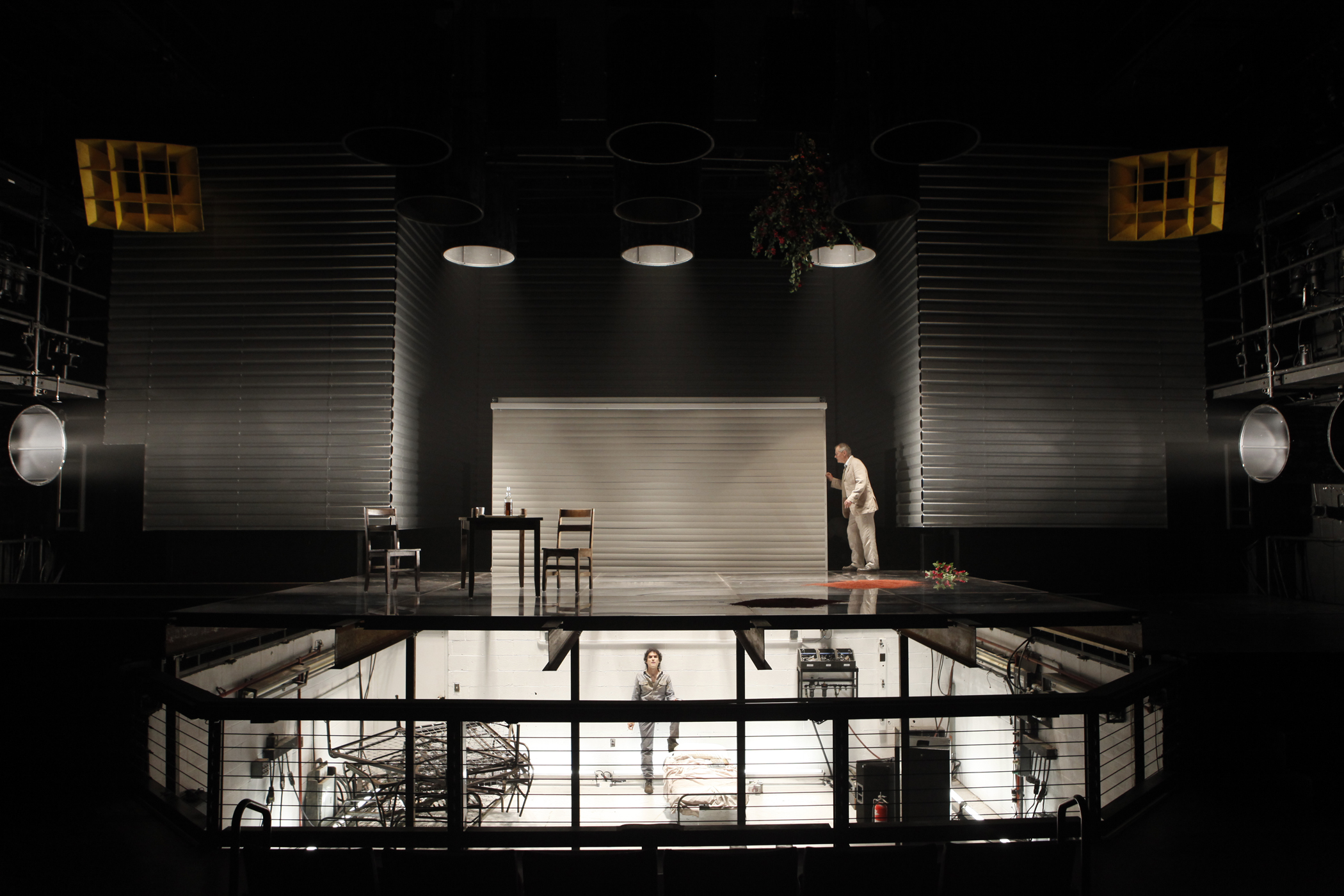
The set, designed by Riccardo Hernandez, is interesting, with a big basement room with a cot and cage visible below -- and more naturalistically furnished than -- the spare stage above,the latter dominated by a kind of shack of corrugated slats, a table for the drinking/gambling, little spots of dirt, and some bougainvillea hanging in the cylindrical lights above. It looks like nowhere on earth, and if we were told it was a construction site on a planet somewhere far, far away, that would be easy enough to believe.
BATTLE OF BLACK AND DOGS, Yale Repertory Theatre, April 16 to May 8, 2010, written by Bernard-Marie Koltès, translated by Michaël Attias, directed by Robert Woodruff; photograph, Joan Marcus
 Review of

 Meyer Levin, a writer best-known for his novel Compulsion, the story of the Leopold-Loeb murder and trial, wanted to be known as the man who wrote a play based on the diary of Anne Frank. He met with Otto Frank to discuss that possibility before Anne’s book had even been published in the U.S.
 Reading Charlotte Garrett Currier’s Shadow and Light: A Retrospective left me conflicted: Had Ijust finished a book of poetry or listened to a Charles Auguste De Beriot movement? Currier incontestably has a vigilant ear for the metrical line unit, creating impeccable rhythms, balancing the traditional formalities of meter and rhyme scheme. Her work is a unique, eye-pleasing integration of extant linguistic idiosyncrasies with avant-garde typography. Perhaps it is fortuitous that I do not have to answer my question of whether Currier writes poetry or composes music. As Dylan Thomas once offered, “Poetry is what makes me laugh or cry or yawn, what makes my toenails twinkle, what makes me want to do this or that or nothing.” At heart, the intent of poetry is to make the audience feel, and feel deeply, and Currier, through this highly metrical almost-memoir, certainly reminds us what it is to wholly feel—whether we wish to be so reminded or not.
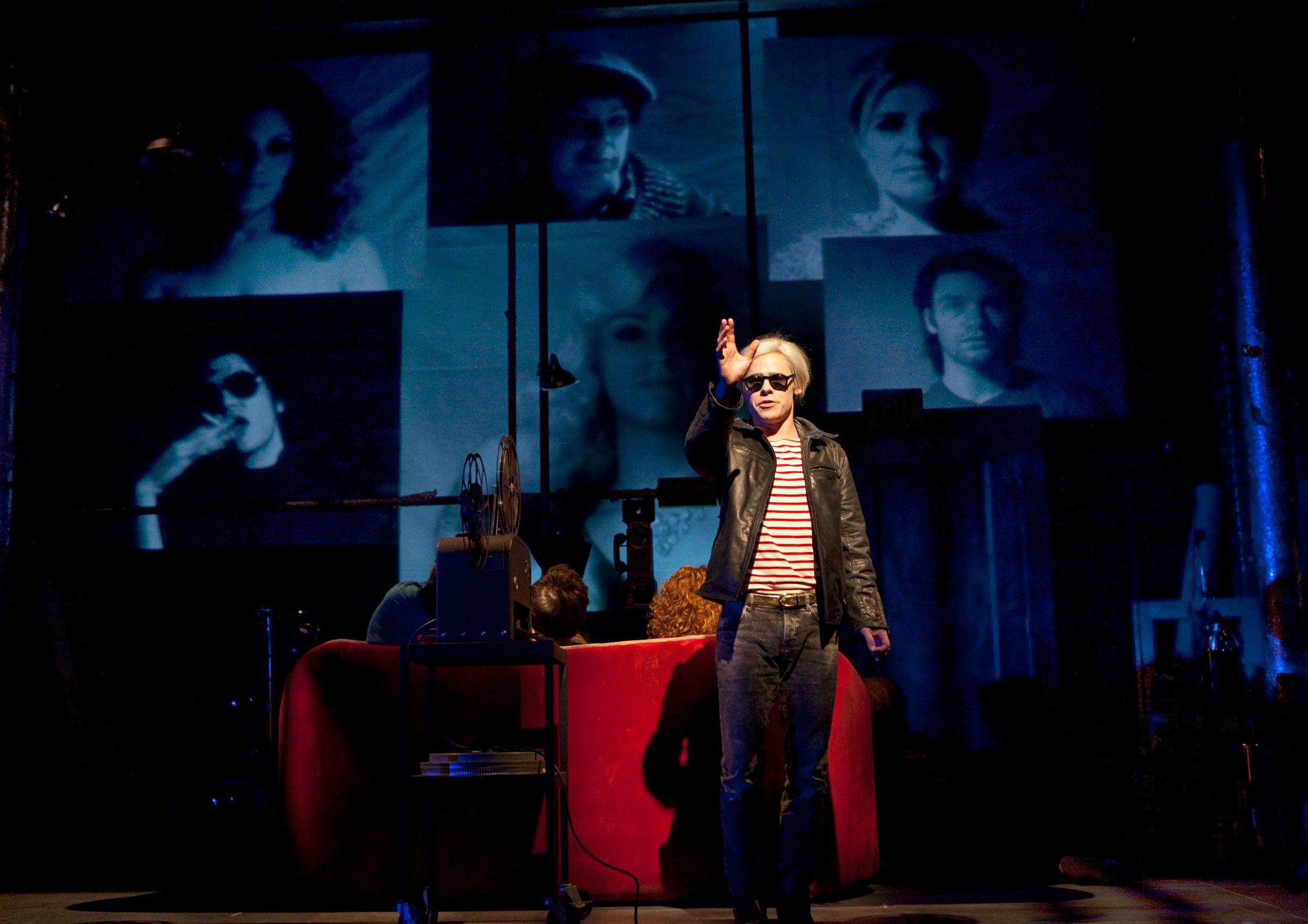 Pop!, the new musical now playing in its world premiere at the Yale Rep, could have been a camp classic: staging a song-and-dance extravaganza on the shooting of famed pop artist, provocateur, and blasé icon Andy Warhol at the hands of a disaffected feminist revolutionary, Valerie Solanis, in 1968. The silver Factory, Warhol’s headquarters at 231 East 47th street in NY, was famed for its stable of hangers-on, including “poor little rich girl” Edie Sedgwick, pre-op transexual Candy Darling, and other would-be geniuses. From this remove, it would be possible to play these characters for laughs, as a collective disgorging of whatever is stored in the closet marked “NYC Underground c. 1967.” Along the way, we might be amused (or not) by the fact that one of these “superstars” had the wherewithal to shoot and critically wound The Master.