News

Story Time: Weekly Live Readings from the New Haven Review

Three months ago, I began to toy with an idea: Wouldn’t it be nice to find a place in New Haven where one could hear short stories read on a regular basis? Several sources contributed to this notion: author talks I had been booking at the Mitchell branch of the New Haven Public Library, reading to my children once upon a time (and sometimes still) before bedtime, catching once in a blue moon the Saturday radio program Selected Shorts, a “poetry crawl” that I organized in my neighborhood. By coincidence, I received a note from David Brensilver, author and director of communications for the Arts Council of Greater New Haven, asking if New Haven Review would be interested in organizing weekly or monthly readings by local authors of their work. I responded right away that I was interested in a weekly reading series, but not of authors and their work, first because there are already very successful monthly reading programs organized by local writers of just this nature in the basement of the Anchor Bar and Restaurant and at the Institute Library respectively, and second, there is no way to maintain a weekly flow of new work without a lot of legwork finding local writers with material ready to read—and that much legwork was something I could not afford.

Since my role with New Haven Review is voluntary—like the rest of the team's—I was looking for something that bridged efficacy and efficiency. Fortunately, in David, I found a soul perfectly amenable to the plan I was concocting, which went something like this. On a weekly basis, actors would read already published short stories at a rotating group of local coffeehouses. Here’s how I put it to him:

Why already published short stories?

Simple efficiency. With already published short stories, the New Haven Review team can build reading schedules far in advance. That meant, among other things, that when it was time to publicize the event, instead of dipping into the New Haven Independent’s Community Calendar each time the next reading was ready, we could load three or four months' worth in one fell swoop. Reading original works or works in progress would require a constant hunt for new material with no guarantee of successful booking.

Why have actors read?

I’ll grant that we New Haven Reviewers are reasonably good readers. We’ve already shown our mettle at public readings in which we’ve participated. But let’s face facts: when you want a great short story to really sing, there is no substitute for a good actor taking the stage—or podium. Having heard my share of writers serve as the readers for audiobook editions of their work, I can assure you ‘tis the better part of wisdom to let actors do well what writers often only do fairly, at best.

Why read at coffeehouses?

Coffeehouses provide space at no charge since they receive added business in exchange. Since this is not a money-making endeavor for us, renting halls and charging for tickets were non-starters. Moreover, since this is an after-hours affair—translation: not for kids—we especially needed coffeehouses that either stayed open at night regularly or were willing to do so for the readings. Finally, the decision to go with several coffeehouses rather than one was based on the idea of spreading the wealth among the neighborhoods of New Haven and coffeehouse schedules. (At present, each coffeehouse is responsible for roughly one reading a month.)

So, will it work?

Beats the shit out of me. I have no idea if New Haven is hungry enough for this kind of thing. I think it is, but it’s primarily a question of getting the word out as aggressively as possible. We figure that with food for thought and stomach in one place, how can you go wrong?
New New Haven Lit Journal!

I am excited to report the existence of , a new literary journal based in New Haven. In their own words: The Dirty Pond is an independent online literary journal based in New Haven, Connecticut. The journal's primary objective is to provide a home for work by New Haven-affiliated writers, with an eye towards curated gatherings in the near future. We will be updating biweekly.

We seek work that is anchored to our fair city without being provincial. We want work that is fierce, compelling, and wonderfully weird. And we're particularly partial to work that is cross-disciplinary and/or collaborative in nature.

We want your short stories and your essays. We want your flash fiction and your poems. We want your photography and your artwork. We want your liner notes. We want sections from your script.

We generally do not want genre fiction, but will grant some leniency, particularly to fanfic.

Most of all, we do not want to be bored.

When you submit, please submit a bio, CV, cover letter, and (if relevant) a myspace/facebook url and a list of upcoming related local events in which you may be participating. Please make sure images are in a standardized .jpeg format, videos and music accessible, and if you're sending us a novel, just give us a heads up.

Please send all submissions along to thedirtypond @ gmail.com (remove the spaces).

Deadline for submissions is September 15, 2009.

First edition goes live October 15, 2009.

Submit, artists, musicians, and writers of New Haven! Submit!

Just Another Band From L.A.?

As I went out one morning a few weeks ago, there was a package at my door. It contained Inherent Vice, the new Thomas Pynchon novel due in stores next Tuesday. The book came my way because I sought the opportunity to review it soon after hearing, not that long ago, that a new Pynchon novel was scheduled for release this summer. As followers of Pynchon no doubt know, his previous novel appeared in November 2006, less than three years ago. Sure, there was only three years between his first novel V. (1963) and his shortest novel, The Crying of Lot 49 (1966), but it’s been some time since any Pynchon opus was followed so quickly by a new work. Gravity’s Rainbow (1973) was seven years after Lot 49, and then there was no new work until a funny, friendly intro to his old short stories, ten years after his National Book Award in 1974. Finally, in 1990, Vineland, a new novel appeared, seventeen years after GR. Then, a mere seven years later, the massive Mason & Dixon in 1997. Almost another decade would pass before Against the Day, formidable at over 1,000 pages, arrived. So, by any estimation, the new novel, at 369 pages, is a quick turn-around for the Reclusive One. It should be noted too, going in, that TP’s short novels are set in California, predominantly. Lot 49, Vineland, and now Inherent Vice. We can think 'California trilogy' if we’re so inclined. And I must add that I’m both inclined and not inclined. I’m inclined because, yes, all three, besides taking CA as their location, also all take a certain 'California State of Mind' as their main theme. When the smoke clears -- and need I tell you what kind of smoke it is? -- what the three novels share is TP’s penchant for both basking in and gently needling the predominant culture of California in the era from the mid-sixties to the early seventies. Indeed, Lot 49 was set only a few years before the year of its publication, lending it an immediacy of setting not common in Pynchon’s works. Vineland, set in 1984, looked back both at the era of Reagan’s re-election and of Nixon’s first term and suggested that, bummer-wise, they had a lot in common, though the Reagan years were worse due to all the ‘karmic adjustments’ that had to be made because of how the Sixties went down. Now, we’re back in Nixonland again, summer of 1970, a year after the Manson murders, about to go to trial, a recurring reference point à la Joan Didion’s take on the Californian ramifications of that event in her essay 'The White Album.'

Why I’m not inclined? No particular reason, I suppose, other than a certain Imp of the Perverse which makes me want to read each of the three CA novels more in terms of what they mean in their particular moments rather than what they mean yoked together as a connect-the-dots of California culture as presented by everyone’s favorite Paranoid Author. In other words, each of the three CA novels feels to me motivated by a completely different ‘trip.’ In Lot 49, the novel is ahead of the curve, satirizing aspects of the day -- who can forget DJ Mucho Maas explaining the effects of LSD -- that hadn’t quite become common currency in 1966, to say nothing of its glance at the Berkeley Free Speech Movement as something simply in the air, though major protests at non-Californian universities were yet to come.

In Vineland, the task was to remind all those who might like to bury their memories of those days, as they rode whatever conservative and generally more lucrative bandwagon through the soulless hype of the Reagan years. But it should be said that the narrative voice of Vineland was more complex than many of its initial reviewers gave it credit for. It wasn’t simply a ‘nostalgia’ trip in which TP, suffering from Tubal Addiction and jonesing for the heady days of tie-dye and patchouli, tried to reignite synapses long grown dormant. The attitude was wiser, sympathetic, but ultimately skeptical, though not snide. A bit like Frank Zappa’s attitude to hippiedom in its heyday, but more affectionate toward those ‘hungry freaks, daddy.’

Then too, both Lot 49 and Vineland treat different aspects of CA: for Lot 49 it’s the area around SF with forays to the fictional San Narciso, closer to L.A. For Vineland, it’s northern CA, Humboldt County, in 1984, with the College of the Surf shenanigans of the Sixties set between San Diego and San Clemente. And this time, in Inherent Vice, it’s L.A. all the way. The prose, enacted through the viewpoint of a Private Eye named Doc Sportello, reads like Raymond Chandler meets Hunter Thompson, and each finds the other simpatico: ‘hard-boiled’ becomes ‘head-fried.’ But one senses the book had to get into print fast, while the ‘groovy vibes’ of Obama-mania are still in the popular consciousness, and that whole Ding-Dong-The-Witch-Is-Dead thing might support cranking back into a simpler time and place where Chinatown’s Jay Gittes and Easy Rider’s Billy are, like, one.

I haven't finished reading it yet, but it’s easily TP’s lightest novel, his most simply entertaining. It might even become one of his most popular if its target audience can stop watching Nick at Nite broadcasts of the TV shows of the era and/or replays of The Big Lebowski long enough to get on board. And I wish we all could be California PIs ...

Letter from the Bronx

Two Saturdays ago, to little fanfare (save long awaited blue skies and an occasional waft of the WKTU Michael Jackson tribute) the opened for the season. Docked in Baretto Point Park in the Bronx, this swimming pool is just like any other of New York City’s fifty-four outdoor basins – offering two sessions daily (11am-3pm, 4pm-7pm), life guards clad in the Parks Department’s signature orange bathing suits and a cool respite from the summer heat. And yet it’s also different: the Floating Pool Lady, which has commanding views of the New York skyline across the East River, began life as an industrial barge in Morgan City, Louisiana. On her decks are three generations of New York City swimmers. “I grew up going to Astoria” Maria tells me, while my daughter and her granddaughter take running leaps into the cold water. Framed by the Chrysler and Empire State buildings, she watches the girls splash in twenty-five meters of sparkling blue. “We’d also go to Lasker,” Maria’s own daughter remembers. “But Astoria has those nice, shallow parts where the little kids play. Plus you can see the Triboro. I mean RFK.” Indeed the pool at Astoria Park, down the East River to the southwest from Barretto in Hunts Point, is the city’s oldest and largest, built by Robert Moses in 1936 to host the U.S. Olympic Team swimming and diving trials. This summer, both the Floating Pool Lady and the Astoria pool provide free swim lessons, lunch and practices for the Summer Swim Team Championship Meet on August 8th. Both parks also have plaques commemorating the wreck of the SS General Slocum, the steamship that embarked on June 15th 1904 from “Little Germany” up the East River towards Long Island for an annual summer picnic. As the ship passed through Hell’s Gate, it caught fire. By the time it beached at North Brother Island, between Astoria and Barretto Point, more than 1,000 of the 1300 passengers – mostly women and children – had drowned.

The Floating Pool Lady was born out of a fascination with New York’s waterfront, past and present. In 1980, while researching her doctoral thesis, city planner and historian Ann Buttenwieser learned that in the 19th Century the city had fifteen “floating baths” moored on pontoons along the Hudson and East Rivers. The idea was planted for a modern day counterpart. Buttenwieser’s dissertation became one of the definitive chronicles of New York water ways, ; this month she will publish (Syracuse University, 2009). In the intervening decades, Buttenwieser has also helped to shape the city’s recreational waterscape, working for a variety of city agencies on river parks, esplanades, kayak launches, ferries to the ballparks and a for the lower Manhattan shoreline.  It wasn’t until 2000, however, that she turned to the floating pool project in earnest, undertaking a feasibility study, enlisting architect Jonathan Kirschenfeld and founding the Neptune Foundation to raise the necessary funds. In 2004, after an extensive search, the Foundation discovered a decommissioned river barge in the bayous of Morgan City. Construction began in nearby Amelia, Louisiana and after some Hurricane Katrina delay the soon-to-be Floating Pool Lady (a moniker also now used to describe Buttenwieser) arrived in New York in 2006 for final outfitting. The floating pool opened on July 4th, 2007 off the Brooklyn Bridge Park, and that first summer hosted 50,000 families.  In its current home in Barretto Point Park Point in Community District 2, it is the only public pool.

Ladies and Gentlemen, the Bronx is swimming.

The street where I live . . .

I have been thinking about turning I wrote about my street, West Rock Avenue, into a book, and so I have been doing a lot of reading about urbanism, town planning, and architecture. Basically, I am trying to figure out what makes some streets livable and others not. A good deal of the literature — by people including New Havener Philip Langdon, whose A Better Place to Live has given me a whole new outlook on what makes a space a happy one in which to dwell — boils down to this: don't depend on cars. People are happier when they can walk to see neighbors, ride their bicycles, and live close enough to their neighbors that they know them. This small-town mythology is one that I am particularly susceptible to, having grown up in a neighborhood that had many of a small town's virtues. And I find myself, as I read these books, falling prey to an unfortunate smugness, as if growing up on streets laid out on an easily navigated grid, with houses on quarter-acres instead of large lots, is the only way to have a happy childhood.

But that can't be right. For one thing, this mythos runs contrary to another important American mythos, the rural farm. I don't think many of us would want to say that children growing up in the countryside, learning to milk cows by their parents' sides, are unhappy. Nobody thinks that that's an uninspiring or despairing way to grow up. And, to be fair, the writers I'm reading aren't reacting against that way of life, which may be dying out; they are reacting against suburban sprawl, which seemed poised to dominate the American landscape.

But what of that suburban sprawl — especially those cul-de-sac developments that have proved so popular in late-20th-century construction? Can one have a happy childhood where there are no sidewalks, where it's too dangerous to ride a bicycle, where there are no secret passageways behind garages or corner stores at which to buy candy?

I don't know. On the one hand, I don't want to underestimate children's capacity for self-mystification. I suspect that most children, at least most of those who grow up middle-class, and sheltered from anything too abysmal in the family's home life, look back at their early years with a certain sense of awe and wonder. Those lookalike houses in Del Boca Vista Estates are not lookalike to the children inside them, who know which house has the best video-game system, which kid has the dad who makes the best forts with the dining room table and some blankets, whose parents go out late and don't hire a babysitter (all the better for watching verboten TV channels).

On the other hand, there is empirical evidence that suburban life of this kind can lead to bad things: obesity, too much time in the car, fewer friends, less play. And teenagers—forget about it. If they can, they flee to the city. Or at least the curious ones do.

But what I don't have are good sympathetic non-fiction books about life in suburban sprawl. For every book critical of that way of life — Langdon's book, Duany et al.'s Suburban Nation, Ray Oldenburg's The Great Good Place — there seem to be exactly zero books about why it can be pleasurable to grow up in spaces that are, after all, safe, predictable, and quiet, which are all good things.

I want the other side of the story. Ideas, anyone?

Search Me

'Of course the company founded by Sergey Brin and Larry Page in 1998 - now reckoned to be the world's most powerful brand - does not offer any substitute for the originators of content nor does it allow this to touch its corporate conscience. That is probably because one detects in Google something that is delinquent and sociopathic, perhaps the character of a nightmarish 11-year-old.'-- Henry Porter, "," The Observer, 5 April 2009

Porter's article, which I found because two Facebook friends linked to it, resonated very tellingly after attending a symposium, 'Library 2.0,' held at Yale Law School on Saturday, April 4.

After an intro that featured much 'lifted' film content and a bright, buzzword-laden welcome that urged us to Tweet and Blog and upload photographs from our cellphones, etc., and a paper by Josh Greenberg of the New York Public Library that celebrated the outreach potential of blogs, we finally got to a presentation, by Michael Zimmer of Univ of Wisconsin-Milwaukee, that offered a few caveats to the collective zeitgeist of online über alles with the notion, picked up from Neil Postman, of technology as always offering a Faustian bargain.

Given the need for the internet in contemporary communications, we might think Zimmer was simply playing devil's advocate or was a Luddite at heart, a throwback to the ancient days before we all went online. But not so, what Zimmer was really cautioning us about was all the unexamined consequences of our lemming-like acceptance of internet interaction. As librarians have had to at times stand up for civil liberties, like the right to privacy about one's intellectual inquiries and sources of information, Zimmer had reason to wonder if 'Library 2.0' -- the library as modeled on Google, essentially -- will continue to provide a 'safe harbor for anonymous inquiry.' Not simply 'who owns the content' of what we post -- but who owns the documentation, who gets to data-mine, and so forth. Ted Striphas, of Indiana Univ., extended this 'Big Brother is Watching' paranoia into Amazon's Kindle system which relays its users' annotations, bookmarks, notes, and highlights back to 'the mothership.'

In the course of the day, there were several references to 'the Death Star': the four huge publishing conglomerates that now exist where twice that many major publishers existed a decade before. But the real 'Death Star' emerged when the topic of Google's digitization plans for out-of-print books was on the table in the day's last panel. Already we had heard, in an excellent presentation by John Palfrey of Harvard Law School, how 100% of a focus group of what he called 'digital natives' (those hitting 13-22 since the major internet wave of the late '90s) used Google to search for information and all went to the wikipedia entry on the subject first. Though Palfrey didn't elaborate on this at the time, the point became clear in the Google discussion when Frank Pasquale, Visiting Professor at Yale Law School, spoke of the possible consequences of putting all our searches for information in the hands of 'proprietary black box algorithms subject to manipulation.' Wikipedia is always the first or second entry in any Google search. The first ten are apparently all anyone looks at. Everything that gets buried by the algorithm is as good as not there. This is not how research is conducted.

Then there's the question of all those out-of-print books. Obviously it would be to the public good to have them searchable and accessible online if only because anything not online or available through Kindle (in other words, anything not part of the Death Star of Google and Amazon) falls into the 'here be monsters' of off-the-map ignorance. Already Jonathan Band, a lawyer, had told us that 'fair use' was becoming more conducive for technological and creative appropriation, and Denise Covey of Carnegie Mellon University Libraries and Ann Wolpert of MIT Libraries had spoken about faculties pursuing an open access policy in which anything they publish can be searched and referenced online -- a blow to academic publishers, but a victory for the notion that research on the internet should not be hampered by commercial considerations.

In other words, the notion of open access to all information, via the internet, of complete 'transparency' of provider and user, was more or less the mantra of the day. But what the Faustian bargain came to seem finally was not with the technology itself, but with giants such as Google and Amazon as the Big Brothers playing Mephistopheles, offering us the interconnected, easy access world of our dreams, but a world where we sacrifice something of our own intellectual curiosity, restlessness, and desire to see outside or beyond that black box algorithm that makes things so easily manageable for us.

Think about how Wolpert pointed out that what made the MIT professors move for Open Access was their realization that, in the world of electronic text, libraries only 'lease' access to online work, rather than owning it like all those printed copies they store in perpetuity. If something happens to the provider or to the lease, all that material is no longer available. And now the publishing world seems poised to turn over all electronic control of out-of-print materials to Google to broker for us, and to disseminate to us according to its lights. As Brewster Kahle, co-founder of the Internet Archive, urged us to consider, there are alternatives. But as Ann Okerson, of Yale Libraries, said at the end of the final panel with a kind of 'fait accompli' finality: if Google accomplishes this digitization, the students and users of libraries at Yale will simply want access to it, and her job will be to work with it, not fight it.

'But it was all right, everything was all right, the struggle was finished. He had won the victory over himself. He loved Big Brother.' --George Orwell, 1984

George Scialabba v’Eretz Yisrael

At long last, the critic is getting . I only met George once, about ten years ago, and I had forgotten how articulate he was in conversation; I was reminded by listening to with Christopher Lydon on his web show (which is as good as anything on NPR). I did, however, want to take issue with one comment George makes—and I hope that my minor quibble will be taken in the context of the huge respect I have for George, who is an essential writer and you should buy and read. At one point, George takes a stab at explaining how many Jewish intellectuals moved right-ward politically; his explanation, and it's not his alone, is that the 1967 war, when Israel's survival seemed to be at stake, caused many American Jews to become more attached to Israel, a country that until then had not been a major part of American Jewish consciousness, especially among intellectuals. Since then, he says, many Jews have been unwilling to follow their progressive principles if those principles might put them at odds with (their perception of) what's best for Israel's survival. And so we can understand how, for example, there was no large Jewish outcry about the invasion of Iraq, which they took to be in Israel's interests. (I hope this is a fair representation of George's position; I'm talking about one or two minutes in a 44-minute interview otherwise filled with fascinating discussions of Randolph Bourne, Walter Karp, and other too-forgotten intellectuals. If this is an unfair statement, I hope George will let me know in the comments section—although I understand if he has better things to do!)

On one level, George is of course right; in fact, he does not go far enough. Israel's remarkable victory in the '67 war not only heightened Jewish concern about the survival of their several million co-religionists in Israel, but it also—more important, I think—increased Jewish pride in identification with that state. Even my fervently anti-Zionist, left-wing grandparents were a little astonished at a country that had produced successful Jewish soldiers (or so my mother recalls). (And here I am reminded of the comedian Jackie Mason's line about the difference between Jews and Italians: Jews are wimps on the street corner, while Italians can f— you up; but put them in an army, and Jews are indestructible, whereas Italians can't shoot straight.)

But I think we have to know which Jews we're talking about. The Jews who became the famous neo-conservatives—Norman Podhoretz and Irving Kristol, most famously—were well on their way to the right before 1967, and they were swinging right in a way that was bound to sweep all their opinions to the right. Indeed, I have often marveled at the sheer, improbably drift of their move to the right—how can it be intellectually honest to just happen to move right on labor, foreign policy, economics, etc., at the same time. Such a comprehensive move is more likely to be the result of cynicism or careerism. There is no reason, after all, why becoming more hawkish on foreign policy also entails becoming more hostile to labor unions. But with these guys, so it went, and there you have it.

Anyway, I don't think 1967 had much to do with where Kristol, Podhoretz, and Himmelfarb ended up. Nor did it have much effect on a lot of Jewish New Left types who were pretty irreligious to begin with, and Jewishly uninterested, and who make up one important core of anti-Zionism today. After all, while most Jews are not anti-Zionists, a lot of outspoken anti-Zionists and Israel critics actually are Jews. Jews may, in fact, be more disproportionately anti-Zionist than they are disproportionately Zionist, compared to the American population at large. Pretty much all Americans are, in their unthinking way, supportive of Israel—a goodly number of Jews, in a very thoughtful way, are critical of Israel. Especially among intellectuals, and that's whom Scialabba is talking about.

So who are these Jews whose foreign-policy ideas were warped, or subtly shifted, by the 1967 war? For whom was the war decisive in that way? The best case could be made, I think, by looking at my contemporaries (I am 34), rather than at neo-cons in the sixties and seventies. I would hazard that a lot of New Republic types (to just pick one useful marker), people like Peter Beinart, say (although there is no reason to pick on him, and he's written a lot about how his position on this has changed), were more inclined to support the Iraq invasion because of having grown up in a post-1967 world where the survival of Israel was an issue for young American intellectuals in a way that it wasn't for, say, my dad.

But I think what George was really getting at is a general despair, his and others', that the same people who have been central—indeed, indispensable—to so many other social-justice movements in America have seemed, to him, relatively absent on foreign policy. And that is a shame. But the causation isn't so simple.

Another point about Jews: most American Jews, even those who went Communist or socialist, have, in their own ways, been very supportive of the American project. This is, after all, the land that saved us from what had been happening, and what lay in wait, in Europe. So that deeply felt Americanism has been channeled into certain domestic progressive causes—like Civil Rights—where it is apparent that the United States is not living up to its ideals. And with our long tradition of women being at least moderately educated, and working outside the home (in the shtetl, scholars' wives often worked to support their husbands endless hours in study), Jews were at the forefront of Second Wave feminism. And there was a history of labor radicalism that Jews brought from Europe. But Jews have not historically been pacifists, and we have been enthusiastic soldiers in every American war (including both sides of the Civil War). It may, therefore, be a bit of a mistake to read into that Jewish progressivism a congenital anti-war inclination. Yes, many Jews were at the fore of the anti-Vietnam movement (although perhaps not out of proportion to our representation on liberal college campuses, where the movement was centered). But it's not my sense that the leading pacifists in the Great War or World War II were Jews—they were Protestants, often of the Anabaptist or Radical Reformation stripe: Quakers, Mennonites, etc., with a smattering of Jehovah's Witnesses, and some more mainline Protestants.

So while it would be nice if there were a strong, identifiably Jewish foreign-policy left today, and in the run-up to the Iraq War, I am not sure that that was ever likely, or that there was a historical precedent, and I don't think its absence is as clearly related to the 1967 war as George Scialabba seems to think.

Artists' Books at Southern

What would William Blake have made of the Kindle, I asked myself the other morning during a private viewing of the Artists’ Book Collection at Southern Connecticut State University’s Buley Library. According to Tina Re, curator of the eighty-book collection, it was Blake who created the first artist’s books when he and his wife, Caroline, wrote, illustrated and bound books such as Songs of Innocence and Experience. Their venture beyond authorship into design, self-publishing and self-distribution remain hallmarks in the realm of artists’ books today.

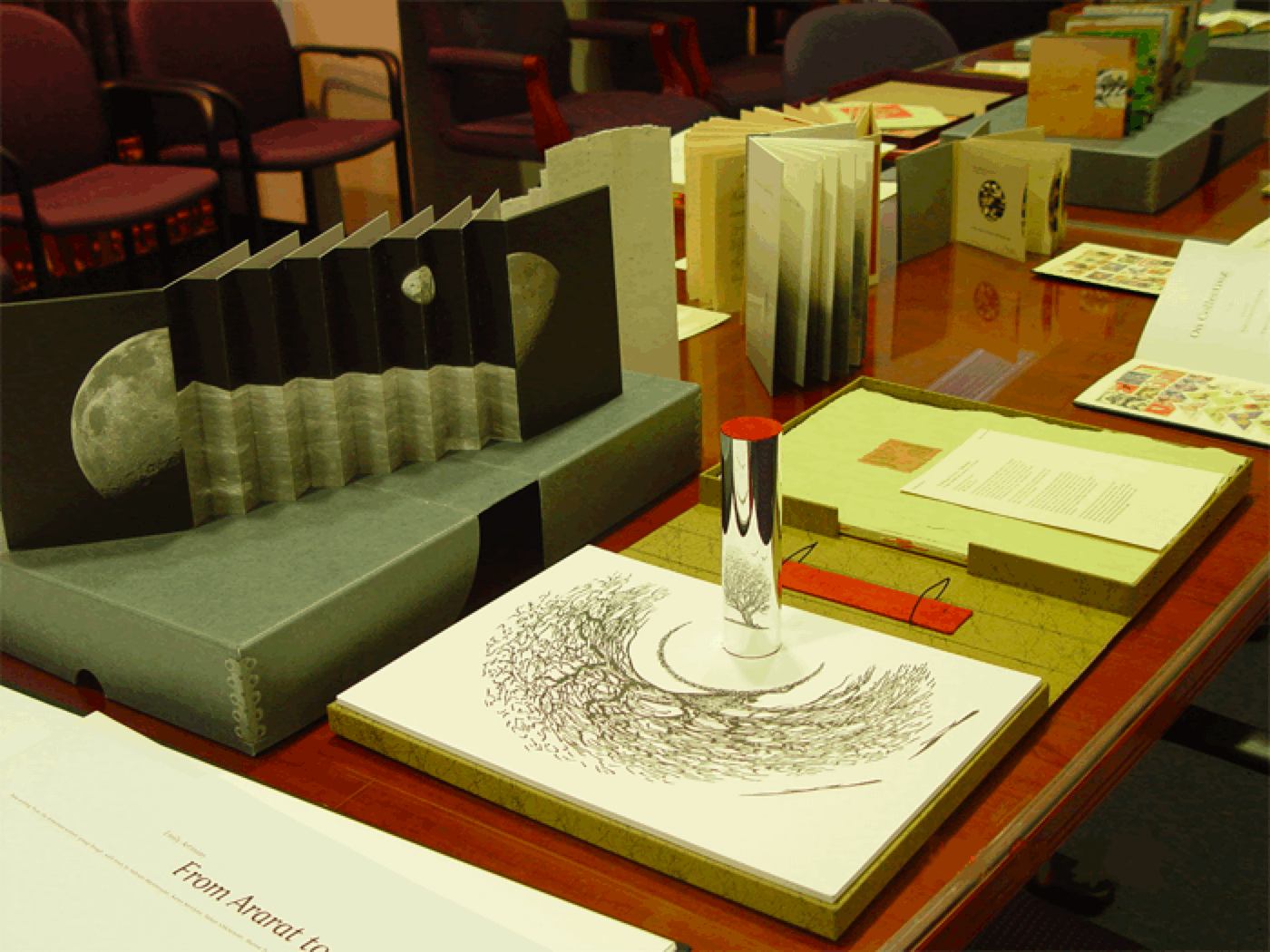
nhrphotoab

“The artist’s book can be purely visual or text, one of a kind or an edition,” Re says, as we walk among tables of books as fans, venetian blinds, flags, accordians, and origami structures, to name a few. “It can take the form of the traditional codex – the book as we know it today, with binding on one side and pages in progression on the other side – or many others. Whatever the case, it’s very much about the artists having control over every aspect of the book.”

Wavy-haired and bespectacled, Re (rhymes with “Fey”) displays the quiet intensity you would expect from a Special Collections librarian. Under constant state budget constraints, she’s been amassing this collection for only three years. It serves mainly as a multi-disciplinary teaching collection for faculty and students, and is presently available to the public largely through private arrangement.

We stop at a book called Aunt Sallie’s Lament, a collaboration between poet Margaret Kaufman and Claire Van Vliet of Janus Press. The words of a Southern quilter printed on thick, colored uniquely-shaped pages that layer and interlock with each other, the book is a harmonious blend of text, image, color, structure and craft.

Next we come upon a portfolio box housing Direction of the Road by Ursula LeGuin with Foolscap Press. It's the story of an oak tree standing in the road, and is a limited edition artist’s book incorporating anamorphic art, first recorded in the west by Leonardo da Vinci in 1485 in a drawing in his Codex Atlanticus. An anamorphic woodcut of an oak tree, intentionally distorted on one axes, becomes proportionate when we view it through an included standing cylindrical mirror. The reflection of the oak tree provides a backdrop to the book itself, which is printed letterpress on white linen paper with fabric leaves pressed into the paper.

“Listen when you read,” Re says to me. And as I turn the pages, the linen paper rustles, like leaves in a breeze. It feels as if we are standing directly below the tree.

I am hooked. I fully comprehend the urge to create a book in its whole, not just as author, but as designer, illustrator, papermaker, typographer, photographer, printer, illustrator, calligrapher, and bookbinder.

Re said that she had similar responses after a recent open house of the collection. Students came up to her demanding to know more about bookmaking and printmaking, and talking about DIY, steampunk and the huge popularity of Esty.com, the site to buy and sell handmade items. It appears that this generation brought up on tactile-less text on the computer, cellphone and Kindle screen are starting to get back to the basics.

William Blake is surely resting easier in his grave.

Letter from New Orleans

Thinking about it now, I pause to think about the ramifications of moving from one new place to another over the past five years—from New York to New Haven and now to New Orleans. After years of banging around various locales in and around New York City, it wasn't too long after I moved to the Elm that I was schooled by two locals on the question of emphasis when it comes to how you actually pronounce New Haven. New Yorkers, it seems, tend to put the emphasis on the NEW! and not the York. "I live in New York, not to be confused with Old York." But here, as Ideat Village impresarios Bill Saunders and Nancy Shea counseled one night, repeatedly, the emphasis, generally speaking, is on the Haven. Not NEW! Haven but New HAAAY-VEN. After awhile I got it; you want to linger on the Haven a good long while, since it is a town that will grow on you. So I started emphasizing the Haven part of New Haven and was therefore able to live here for over four years. When it comes to New Orleans, hey, I'm having a hard enough time pronouncing some of these street names without worrying too much about where the emphasis ought to lie. Post-Katrina you could argue for NEW! Orleans, but that sounds like Chamber of Commerce-approved marketing of the most vanilla-cynical variety. Besides, the blessed and endemic lassitude of the Big Easy begs for a lingering over the Orleans. On the other hand, from a fact-checking point of view, there is an Orleans with which one can make a differentiation. So I have been worrying about it, but not too much.

The other day I was walking in the Marigny neighborhood of New Orleans, which, I have learned, is not pronounced “ma-RIG-knee,” and came upon one of those those Volvo sub-wagons you see in every town, festooned with an abundance of bumper stickers citing various locales, pols and causes. Amid the Hillary! Stop War! and Peace is Patriotic stickers was one trumpeting the glories of . . . New Haven!—complete with an accompanying icon, a slice of pizza. The nudgenik in me thought, "Hey, that's wrong! None of the legendary places in town sells pizza by the slice! Outrages!"

But seeing that bumper sticker, indeed the whole trove of them, did evoke yet another question of where to put one's emphasis, this time when it comes to the old canard, "Everything in moderation." It's one on the great cautionary aphorisms of all time, but that's only because most of us put the emphasis on the moderation. Embedded within lies the stunning and deeply gratifying notion that if you can swing the moderation, you can have everything!

And so there we were, the winter of 2008, myself and Bill and Nancy, and the writer Todd Lyon. By then I knew how to tell people I lived in New Haaaay-ven and it had stopped bothering me that my friends from New York would always want to know how I was enjoying Hartford. In any case, we had an agenda. Oh, such a one as it was! We would hit four pizzerias in one night. We'd start at Zuppardi's in West Haven, get the double-dose at Sally's and Pepe's, and then grab a capper pie at Modern.

A slice here, a slice there, no gastro-problems would ensue if we paced ourselves; that was the plan. Alas. Immoderation won out in Wooster Square and we never made it to Modern. As for BAR, we kept it off the list. Too new, relatively speaking, to qualify for the tour.

Summary Observations: The Movie

Aside from intellectual property attorneys, who really knows where to get good movie ideas? Julie & Julia, due in theaters this August, is Nora Ephron's movie of Julie Powell's memoir (originally a blog) of the year she devoted to making every recipe in Julia Child's famous cookbook, Mastering the Art of French Cooking. Starring Amy Adams as Powell and Meryl Streep as Child, it is said to be the first wide-release movie developed from a book developed from a blog developed from a cookbook. And it just goes to show that potential entertainment properties are lurking everywhere. What most interests me, though, is its implied confidence in the supremacy of storytelling. If this film succeeds, it might inaugurate a whole new cinematic subgenre of movies dramatizing the doing of things described in instructional books.

Is an adaptation of Harold Bloom's How to Read and Why finally at hand? If so, what would it require? Perhaps the enterprising screenwriter might invent some twenty-something everyman, poised on the brink of self-actualization, and cross cut his intellectual development with telling formative vignettes from the life of Bloom?

Already I can picture our young, book-addled hero, sitting in an uncomfortable chair and contemplating “the vagaries of our current counter-Puritanism,” with the camera swirling and the music swelling around him; or standing by his apartment window, gazing out into the dusk and bearing in mind that “Irony will clear your mind of the cant of the ideologues, and help you to blaze forth as the scholar of one candle.” It began with Jason Schwartzman in contention for the part, but now I’m seeing Michael Cera.

So OK, it’s looking like this will be a Ron Howard picture, dumbed down just enough for mainstream safety and perhaps controversial in its casting of Tom Bosley as Bloom (certain members of the blogorati having lobbied in vain for Martin Landau). A box-office success? Maybe. An Oscar magnet? Well, sure, as long as it gets across the notion that “We read not only because we cannot know enough people, but because friendship is so vulnerable, so likely to diminish or disappear, overcome by space, time, imperfect sympathies, and all the sorrows of familial and passional life.”

And if that doesn’t work out, there must still be a good movie to be made from How to Complain for Fun & Profit: The Best Guide Ever to Writing Complaint Letters, by Bruce Silverman. Or at least from The Garden Primer, by Barbara Damrosch.

Secrets of a Publishing Addict

I like to tell this story, having told it many times before. Sitting at home, I receive a call from a friend asking if I had seen that week's copy of , for which she then worked.

"No, I haven't. Why?"

"Well, there's an interesting article about this guy who started a local book review, like the one you and I thought about doing years ago."

And, lo and behold, so it was. Where I no more than dreamt, another made happen. Thus was the born. Fortunately, for me, its was also a fellow member. So when he entered the lobby doors, child and stroller in hand, I approached him.

"I saw the article about the New Haven Review of Books. I'd like to help."

"Oh, that's great," he replied. "Do you write?"

Do I write? That was a tough one, actually. "Sure, I write a little, but I'd rather be your publisher"—if you'll have me—I thought parenthetically. I had served as the publisher of a Jewish literary journal in graduate school and I wanted to return to that more distinctly literary scene after years in .

"Our publisher? You mean like sales and marketing and stuff like that…"

"Yes, stuff like that."

"Great! No one else wants to do that!"

Thus was a partnership born, and I was joined at the literary hip to an editorial collective of individuals wiser and more talented than myself—and with infinitely better connections, too.

But this was all fine by me. I like the business of publishing, from handling the filthy lucre to freaking out over missing a print deadline. True that in this endeavor I would have less occasion for the give and take of reading and responding to the lucubrations of the published and hoping-to-be-published. But would it be all too sickening to admit that I like fiddling with our circulation database, hounding subscribers for renewals, holding out my greasy palm for potential contributions, even filling out the occasional nasty legal form? Probably, but what can I say? I love it.

Publishing, for me, is in the blood—all aspects of it, from correcting misplaced commas to panhandling in the street for new readers.

So, ready to subscribe?

Issue 3 Available Now

We are delighted to inform you that Issue 3 of the New Haven Review, featuring essays, fiction, poetry, and photographs from Jim Knipfel, Jess Row, Willard Spiegelman, George Witte, Stephen Ornes, Ian Ganassi, Nick Antosca, Joy Ladin, and Desirea Rodgers is available now. We'll have the entire issue online shortly, but if you'd like to have the actual journal in your hands—which, designed by Nicholas Rock, is truly a thing of beauty—please contact us. We'd love to hear from you. And thanks once again to all our contributors, subscribers, and supporters for making this possible. Brian Francis Slattery is an editor of the New Haven Review.

NHR party/Palin poetry/NHR author signed to Pantheon

First things first: the issue #3 launch party will be at Labyrinth Books, 290 York Street, New Haven, from 6pm to 8pm. Please come! Second, we are thrilled that after we wrote about essayist an undiscovered literary treasure, an agent on our email list contacted him, they got together, and now he has a two-book deal with Pantheon. Congratulations! (And glad we could help.)

Finally, a couple weeks back, we put out the call for poems about Sarah Palin. We just had a hunch that out there, somewhere, somebody had decided that Sarah Palin merited verse. A lot of great poems came in, but the sure winner, for dedication if not for quality, has to be the blogger at who in the past few weeks has turned her (why are we so sure it's a “her”? we could be wrong) blog over to the versified crucifixion of Alaska's leading

Review Hiatus Continues; Dispatches in America

As the above title suggests, the New Haven Review's hiatus continues. In the meantime, we commend to your attention John Stoehr's of Dispatches in America, the first issue released by Dispatches, a quarterly journal and concern with a fascinating and . May we hear much more about Dispatches as it progresses. is an editor of the New Haven Review.

Review Hiatus; Summer Book Group This Wednesday

The New Haven Review's August hiatus from reviews begins this week as we line up website reviews for the fall and edit Issue 3 of the print edition, which will appear in November. (Yes, we hope to throw another party. We can't help ourselves.) We would also like to remind New Haven-area readers that our final meeting at is this Wednesday at 6 p.m.; New Haven Review contributor Steven Stoll will discuss David Harvey's . For those unfamiliar with the term, neoliberalism is the catchall phrase for the dominant economic ideology of our time — liberalized capitalism — and the various political and social policies associated with it that have changed the world in profound ways. As the ideology is championed, reviled, elided, and misunderstood in nearly equal measure, a discussion of neoliberalism should be about as lively as discussions get. As always, Labyrinth provides the wine and cheese. See you there!

is an editor of the New Haven Review.

New Haven Review Summer Vacation

In deference to Independence Day, the New Haven Review has taken this Monday off. It will also take off the Mondays in August, as we know that nearly everyone — well, everyone in publishing, anyway — goes on vacation; and even if they don't, nobody wants to be inside, hunched over a computer, when they could be outside, on the beach, drinking a gin-and-tonic from what is ostensibly a water bottle while three children nearby bury their father up to his neck in the sand. But we will be back next week with more reviews and will resume again, full throttle, in September. Meanwhile, Issue 3 of the New Haven Review, due out in the fall, is shaping up to be a doozy. We have an essay from Jim Knipfel, a piece from Willard Spiegelman (editor of the Southwest Review), an excerpt from Jess Row's new novel, an interview with David Orr, and numerous other essays, poetry, and fiction from people you may not have heard of yet, but will soon. Stay tuned.

Thanks, New York Times!

If you're here because you've followed the from Rachel Donadio's generous mention of us (thanks!) in the New York Times blog , welcome. Please have a look around. Our weekly reviews appear right here on this page; you can find the contents of the print editions .

Despite our fondness for the Greater New Haven area, we really are interested in submissions from anywhere. So if you have an idea, for the print edition or the website, do write us. We'd love to hear from you. And thanks for reading.

is an editor for the New Haven Review.

Thanks, New Haven Register...

...and Donna Doherty specifically for the generous of our publication that appeared in today's paper. The actual physical newspaper included this snazzy photo of editor Mark Oppenheimer, publisher Bennett Lovett-Graff, and Mark's daughter Rebekah in dramatic lighting:


Mark, Bennett, and Rebekah


What the article says is all true too. So, Greater New Haveners: If you're interested in submitting, we're looking forward to hearing from you. If you're interested in subscribing, we thank you in advance. And if you're just here to read what we've published and posted so far, welcome. Take your time and have a look around. We hope you like what you see.

is an editor of the New Haven Review.