 “Art” by Yasmina Reza first appeared in Paris in 1995. Shortly afterwards it was translated into English for the British stage and turned up at the Royale Theatre (now the Bernard B. Jacobs Theatre) on Broadway on March 1, 1998. The cast was stellar for this three-person play, performed without intermission. The six-month Broadway run included Alan Alda, Victor Garber, and Alfred Molina, all well known film and theatre performers.
The recent weekend performances of the play at the Kehler-Liddell Gallery in Westville this April were perhaps a little less glamorous but were easily just as powerful as its Broadway version—in some ways even more so. Where the Royale Theatre seats 1,100, Kehler-Liddell’s impromptu bleachers and 60 some chairs transformed what on Broadway can only have been an all-too-impersonal experience into an intimate tete-a-tete between audience and performers. Placing the play within a gallery reflected, if anything, the mutual trust exhibited by gallery staff and the Elm Shakespeare Company, which was responsible for this production.
This element of trust is no small matter in a play as powerful as Reza’s. The setting is simple enough: the living rooms of the three characters—Marc (James Andreassi), Serge (Tom Zingarelli), and Yvan (Raphael Massie)—which remains unchanged throughout the hour and twenty minute performance. The key conflict is unsettling, one that should worry any gallery owner in the business of selling art. In brief, Serge, a dermatologist and divorcee, has purchased for 200,000 francs a five-by-four-foot painting of white lines on a white background. This decision immediately upsets Marc, an engineer who condemns the work as trash, to the dismay and disdain of Serge. Their seeming arbiter is the hapless and “chaotic,” soon-to-be-married Yvan.
While hardly a tale of war or woe, Reza’s play disturbs the universe of art and, as becomes shortly evident, human relations. The opening gambit in Reza’s backhanded criticism of postmodern art—and possibly of poststructuralism, a distinctly French phenomenon that Reza undoubtedly had to live through—is the all-white painting that is the object of Serge’s veneration, Marc’s rage, and Yvan’s confusion. But “Art” goes beyond the obvious conundrums formerly presented by Marcel Duchamp’s institutionalized snow shovels and urinals. (Does something become ‘art’ by virtue of hanging in a museum? What if you pay 200,000 francs for it?) It goes after the relationships among the characters, since it’s on the blank whiteness of the canvas that their relationships are ultimately inscribed, evoking a range of emotion that drives them through the convolutions of feeling that by play’s end leaves the audience near breathless with the verbal pyrotechnics of it all.
This is where mastery of the material makes all the difference, and the ensemble put together for this production really does have firm control of that material. The snugness of the venue and the simplicity of the set demand a conciseness of body language that is belied by the explosiveness of the characters’ pent-up feeling. The contrast of so much energy to be conveyed in so contained a setting ultimately creates a bond between players and spectators that only a great performance in the right environment can convey.
This simpatico between audience and ensemble seems exactly the intended goal of this experiment by Elm Shakespeare Company and Kehler Liddell Gallery to bring high art of high quality to New Haven’s neighborhoods. “Westville is something of an arts district already strong in the visual arts with its many galleries,” noted Elm Shakespeare founder and director James Andreassi. “Elm Shakespeare’s goal was not only to find an indoor space for performing smaller plays but also to take advantage of the artistic energy in Westville and deepen it by bringing the theatrical arts to the neighborhood.” In that regard, Elm Shakespeare both follows in the wake and leads along with works that have been aired by New Haven Theater Company, Broken Umbrella Theatre, and Theatre 4.
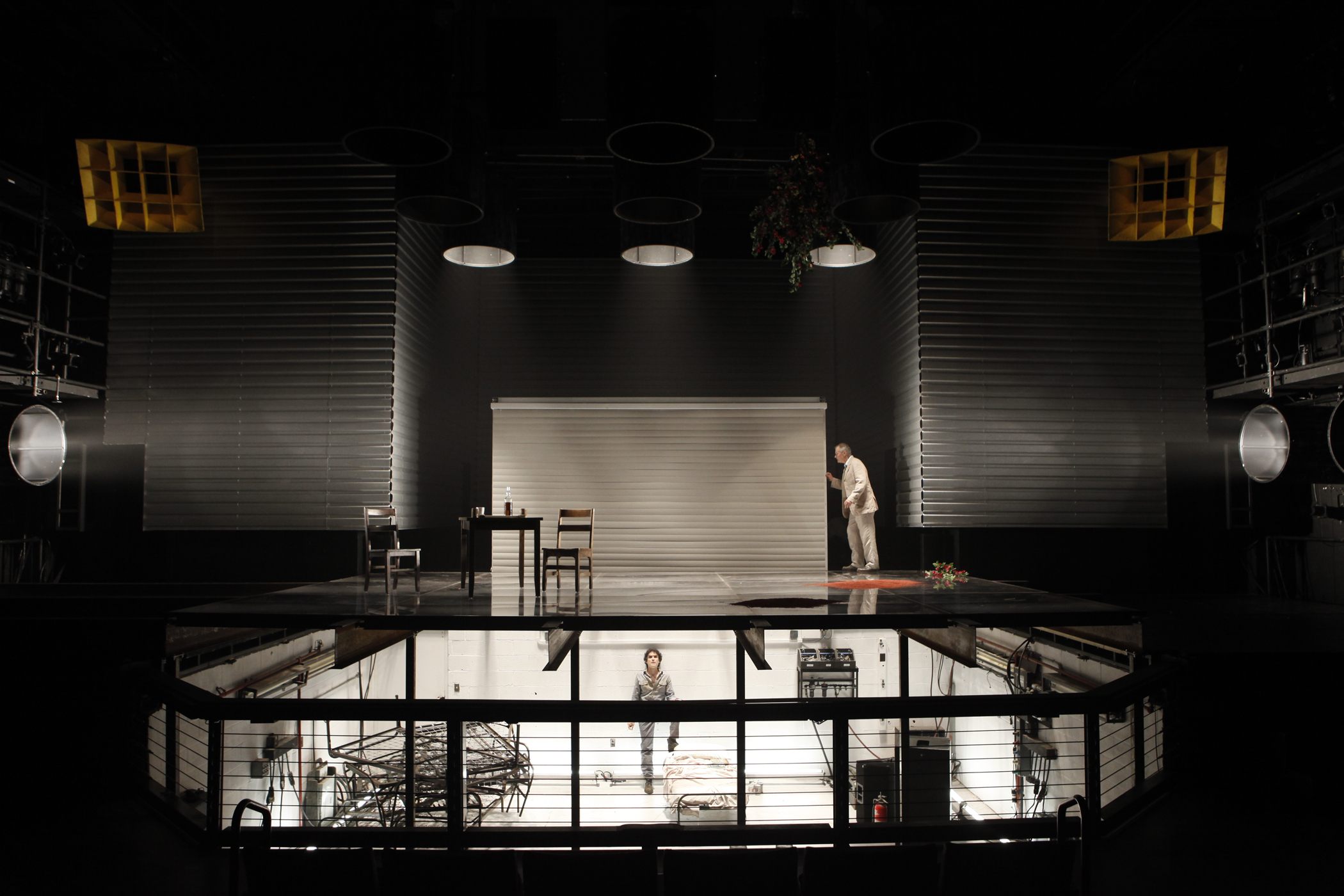 Bernard-Marie Koltès' Battle of Black and Dogs (Combat de nègre et de chiens), translated by Michaël Attias, and directed by Robert Woodruff, is the second play this season at the Yale Rep to take us to vague environs in Africa to witness a drama among a small group of people cut off from the world at large. Like Danai Gurira's Eclipsed, BBD places us in a compound, but this time it's a "construction site run by a foreign company in a West African country, anywhere from Senegal to Nigeria," where the main characters, white and French, are confronted by Alboury (Albert Jones), a member of a local Wolof tribe who wants to retrieve the body of a worker at the site who has recently died or been killed.
 Review of

 Meyer Levin, a writer best-known for his novel Compulsion, the story of the Leopold-Loeb murder and trial, wanted to be known as the man who wrote a play based on the diary of Anne Frank. He met with Otto Frank to discuss that possibility before Anne’s book had even been published in the U.S.
 Reading Charlotte Garrett Currier’s Shadow and Light: A Retrospective left me conflicted: Had Ijust finished a book of poetry or listened to a Charles Auguste De Beriot movement? Currier incontestably has a vigilant ear for the metrical line unit, creating impeccable rhythms, balancing the traditional formalities of meter and rhyme scheme. Her work is a unique, eye-pleasing integration of extant linguistic idiosyncrasies with avant-garde typography. Perhaps it is fortuitous that I do not have to answer my question of whether Currier writes poetry or composes music. As Dylan Thomas once offered, “Poetry is what makes me laugh or cry or yawn, what makes my toenails twinkle, what makes me want to do this or that or nothing.” At heart, the intent of poetry is to make the audience feel, and feel deeply, and Currier, through this highly metrical almost-memoir, certainly reminds us what it is to wholly feel—whether we wish to be so reminded or not.

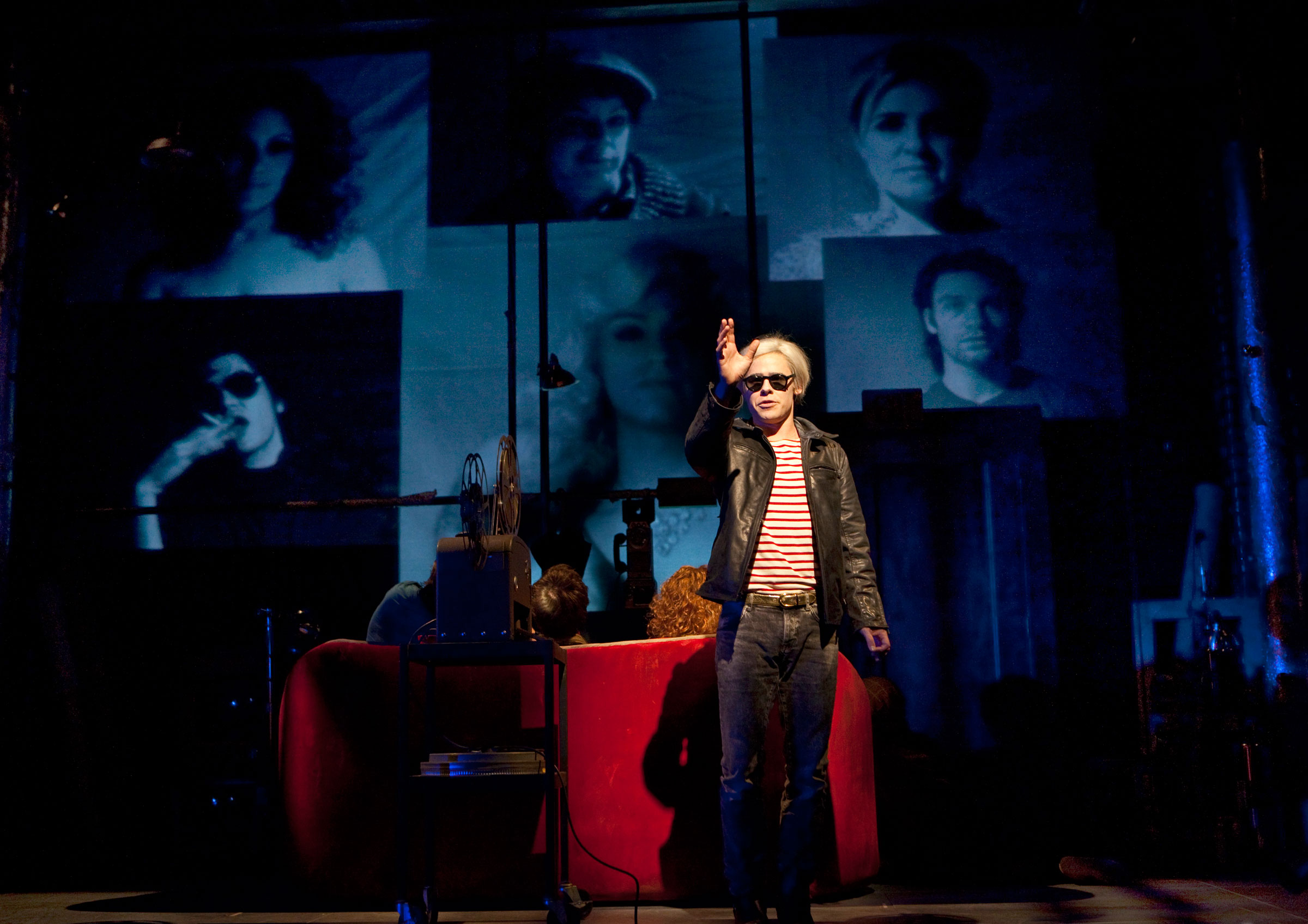 Pop!, the new musical now playing in its world premiere at the Yale Rep, could have been a camp classic: staging a song-and-dance extravaganza on the shooting of famed pop artist, provocateur, and blasé icon Andy Warhol at the hands of a disaffected feminist revolutionary, Valerie Solanis, in 1968. The silver Factory, Warhol’s headquarters at 231 East 47th street in NY, was famed for its stable of hangers-on, including “poor little rich girl” Edie Sedgwick, pre-op transexual Candy Darling, and other would-be geniuses. From this remove, it would be possible to play these characters for laughs, as a collective disgorging of whatever is stored in the closet marked “NYC Underground c. 1967.” Along the way, we might be amused (or not) by the fact that one of these “superstars” had the wherewithal to shoot and critically wound The Master.