Review of Hedda Gabler, Yale Repertory Theatre
Hedda Gabler is my favorite play by Henrik Ibsen and one of his best known. Even so, as I learned to my regret once when I casually mentioned to a student what becomes of Anna Karenina, one must be careful with spoilers. Watching Hedda Gabler on its opening night at Yale Repertory Theatre last week underscored for me the fact that you can only see it for the first time once, and that happened for me long ago. Which might be a way of saying: if you haven't ever seen or read Hedda Gabler, then you should try to get a ticket to this masterpiece, playing through December 20. And even if you do know the play, it's well worth seeing it done again, in Paul Walsh's swift and more contemporary translation, with a very able cast, and presented (with scenic design by Jessie Baldinger, costumes by Lyle Laize Quin, and lighting design by Larry Ortiz) in the style of a late 19th-century bourgeoisie almost poised for affluence.
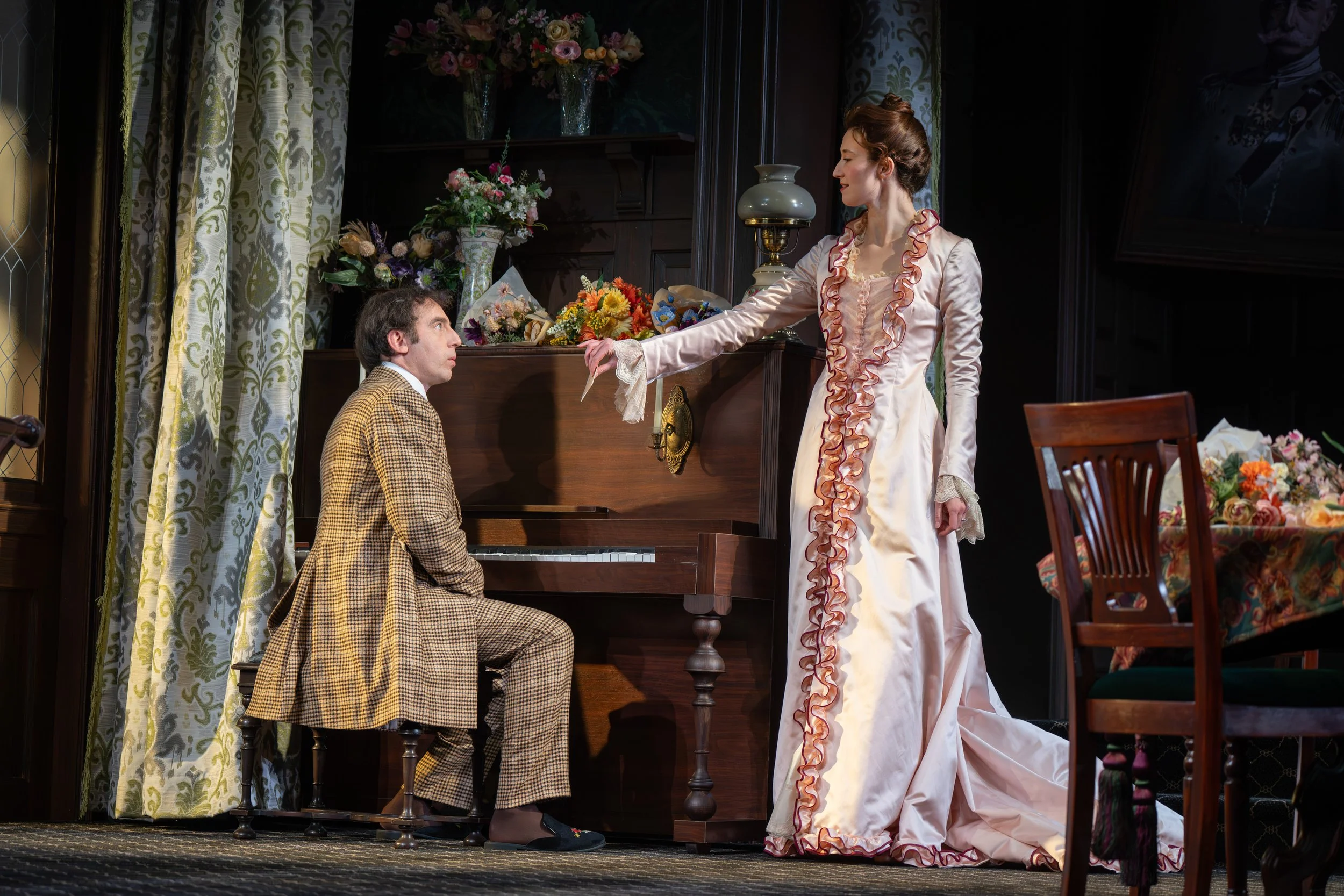
Jorgen Tesman (Max Gordon Moore), Hedda (Gabler) Tesman (Marianna Gailus) in Hedda Gabler, Yale Repertory Theatre; photo by Joan Marcus
Directed by James Bundy as his final offering as Artistic Director of the Rep and as Dean of Yale's David Geffen School of Drama, the Rep production is faithful and solid, a classic presented in a classic manner. And that's important because, as the playbill essays by the production's dramaturg Timothy Hartel remind us, Hedda Gabler is a play very much of its day, the 1890s in Norway. Should that seem a remote destination, reflect: Ibsen wrote plays to stir things up, not least his time's staid conventions concerning the status of women. And so Ibsen's plays seem to play best in conservative periods like ours, in need of a jolt to remind us how far we have—had?—come. Here, much of the play's tension centers on the restless discontentment of Hedda, played with engaging spontaneity by Marianna Gailus. Her Hedda's malice seems more casual than premeditated, and so the plot elements artfully contrived by Ibsen to hem her in achieve full resonance.
There's a moment about midway through the play that is definitive. Hedda goes to her desk where a set of her father's pistols and a secreted manuscript are stored—both items intrinsic to the plot. She might be after one thing or the other and, as we watch, perhaps we aren't certain which she will take. The staging of the scene made me believe that just for a second maybe Hedda wasn't certain either. The briefest pause in the scene gives a lasting impression of how Hedda's comments and actions come—as she says—"out of the blue." And from her choices all else follows.
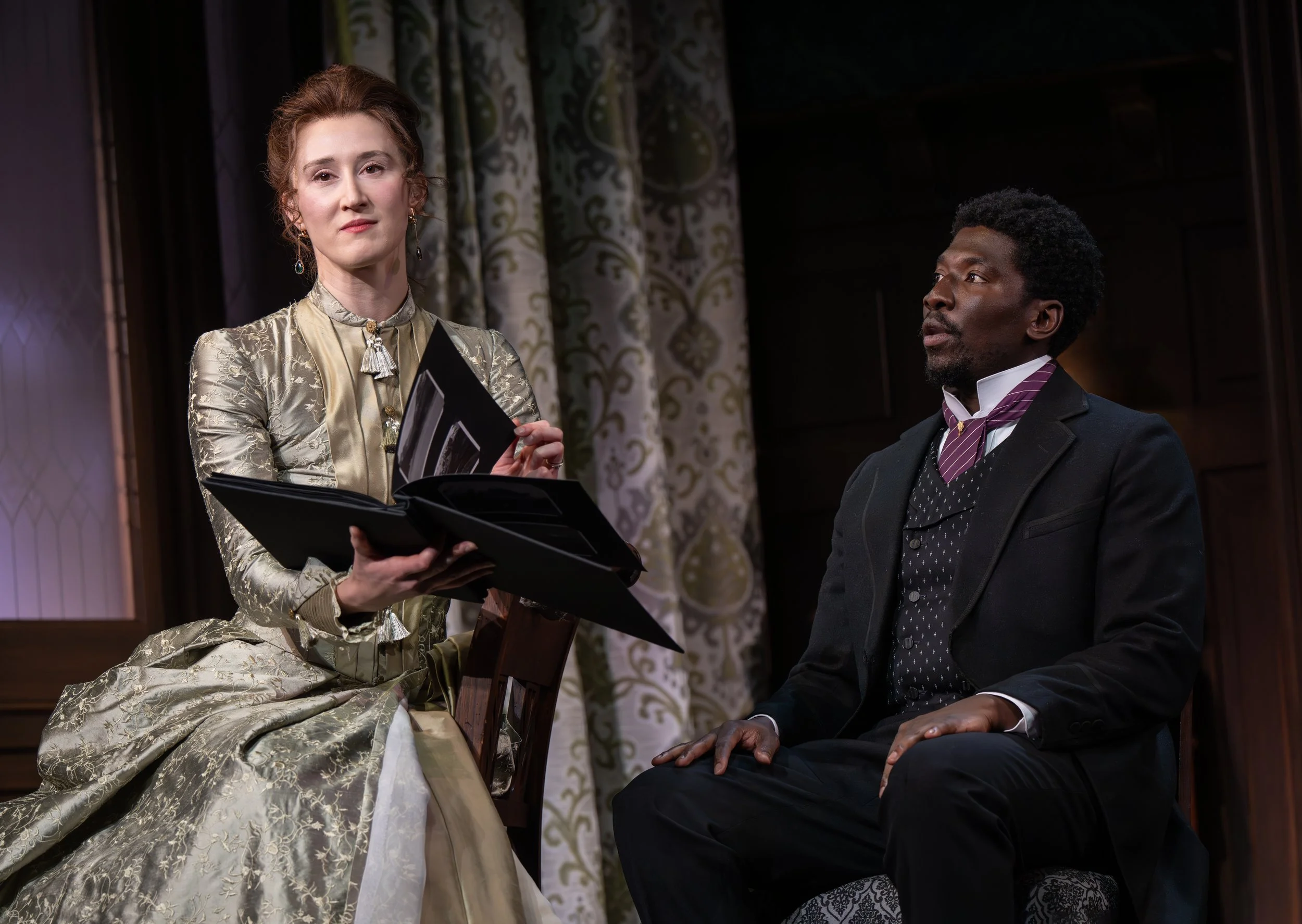
Hedda (Gabler) Tesman (Marianna Gailus), Eilert Løvborg (James Udom) in Hedda Gabler, Yale Repertory Theatre; photo by Joan Marcus
The basic plot concerns the newly married Tesmans—Jorgen (Max Gordon Moore) and Hedda, formerly Gabler, a high-spirited and well-born young woman whom no one expected to marry a plodding and unimaginative man like Tesman, a scholar who seems at best a safe bet for a woman who sees herself as past her prime and "danced out." We learn, gradually, that one of Hedda's secret passions was for the much more inspired and adventurous scholar Eilert Løvborg (James Udom), purportedly a genius who, in their youth, kept up a long friendship with Hedda that might have been and almost was consummated. In a key scene in Act II, Ibsen's dialogue very carefully delineates the extent to which the pair can manage to describe or agree upon what they once were to each other. Back before Hedda was married, and before Eilert became dissipated, only to be "reclaimed" by the patient and, in Hedda's view, "mousy" Thea Elvsted (Stephanie Machado), formerly Rysing. Thea, it's implied, was someone Tesman felt drawn to until Hedda turned his head. So we have a neat set-up of mismatched couples, the stuff of drawing-room comedy, except . . . Hedda, bored, thwarted, with still a dream of "controlling someone's destiny," plays with others for her own amusement, but isn't aiming for laughs. She wants Eilert to achieve something "beautiful," "with vine leaves in his hair," as though a Dionysian poetic figure. And yet Eilert is no more such a figure than is Tesman or Judge Brack (Austin Durant), a powerful admirer. At one point, Hedda confesses herself a coward, a feature shown by her attempts to live through men who will fail her ideal.
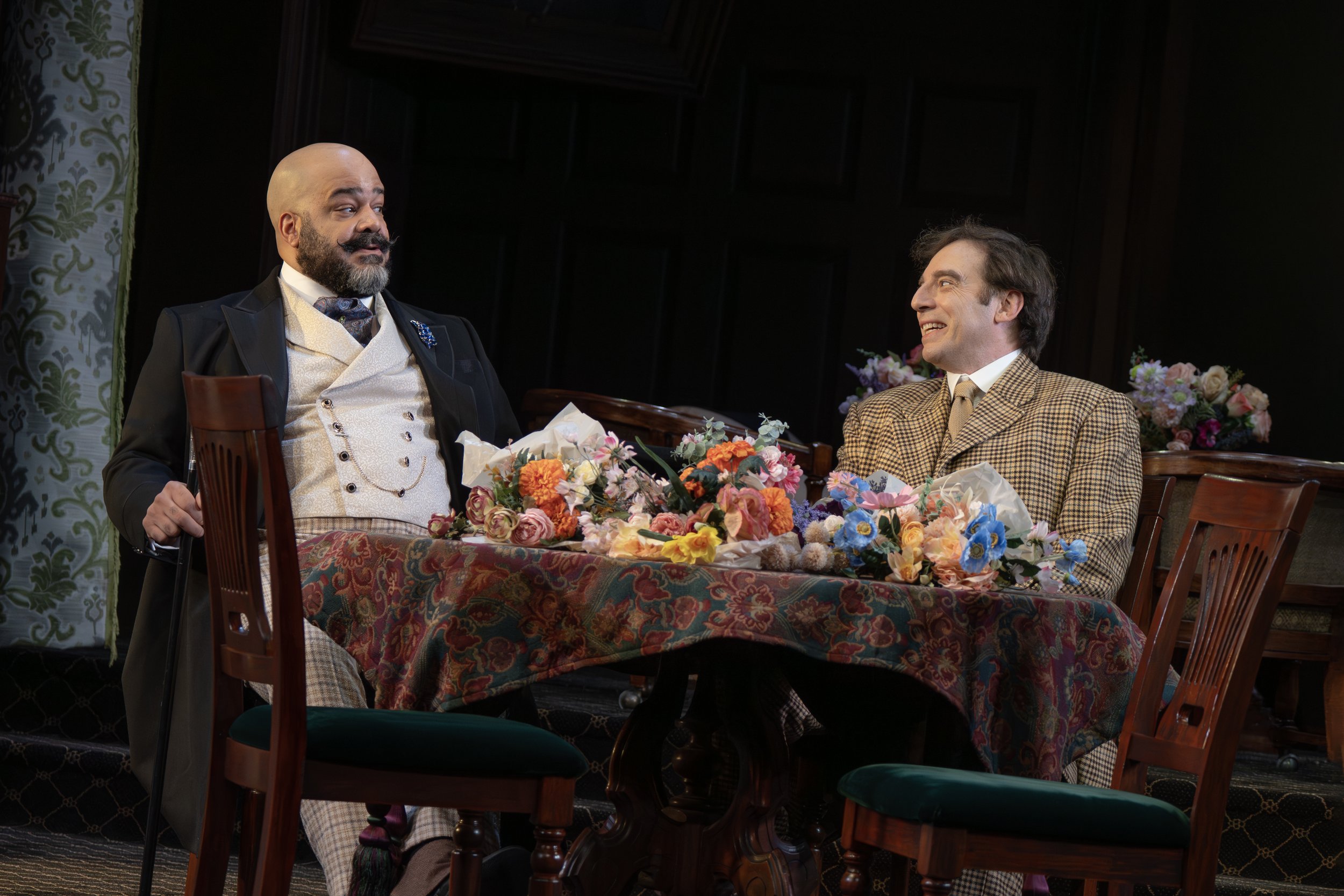
Judge Brack (Austin Durant), Jorgen Tesman (Max Gordon Moore) in Hedda Gabler, Yale Repertory Theatre; photo by Joan Marcus
Ibsen's characters require careful casting, if one would be faithful to the playwright's conception. Bundy's supporting cast—most graduates of the Yale acting program—step into their roles effortlessly. Max Gordon Moore plays Jorgen Tesman as the somewhat befuddled figure he often is: full of vanity and uncertainty, trying to make the best of each setback, never quite grasping where the disturbing faultline in his domestic happiness lies; Austin Durant's Brack is a self-satisfied slyboots, proud to consider himself "the only cock in the henhouse" and willing to do whatever is necessary to maintain his status. He's a charming schemer who likes to come and go through "the back way" so as not to be announced.
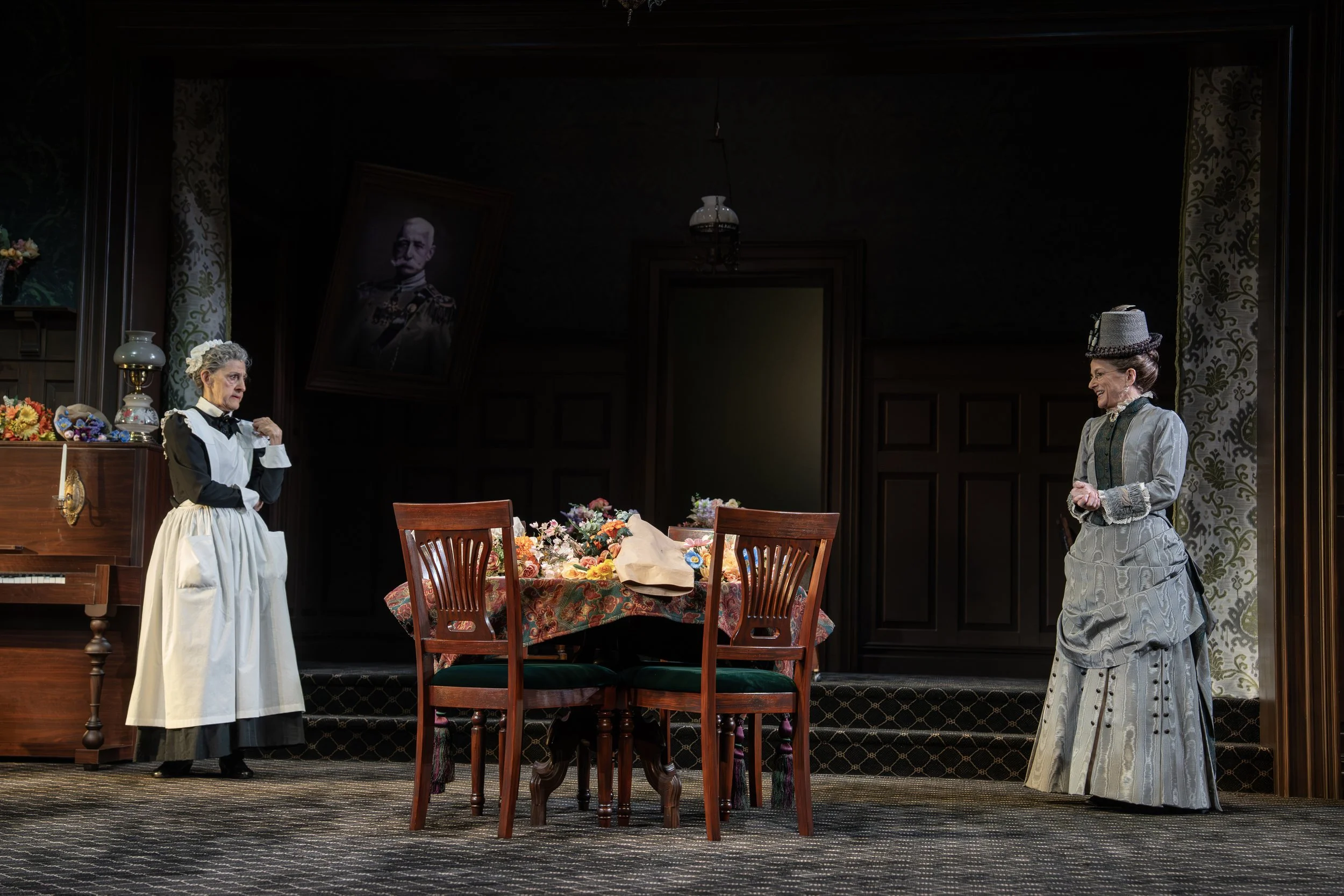
Berte (Mary Lou Rosato), Aunt Juliane (Felicity Jones Latta) in Hedda Gabler, Yale Repertory Theatre; photo by Joan Marcus
Other essential support comes from Felicity Jones Latta as Tesman's Aunt Juliane and from Mary Lou Rosato as Berte, the serving-maid who has moved from Juliane's home to the fancy new home purchased, on promises of an academic appointment, by Tesman. Without Aunt Juliane to coo at Hedda and fuss over Tesman, the domestic situation would lack its sharp accents. In the first scene, the musings between Jones Latta's Juliane and Rosato's Berte set the tone and mood, from a hedging acceptance of the newlyweds to financial concerns when Tesman arrives to a prickly welcome by Hedda. All of which helps to establish the comedy of manners we are in fact watching, up to a point.
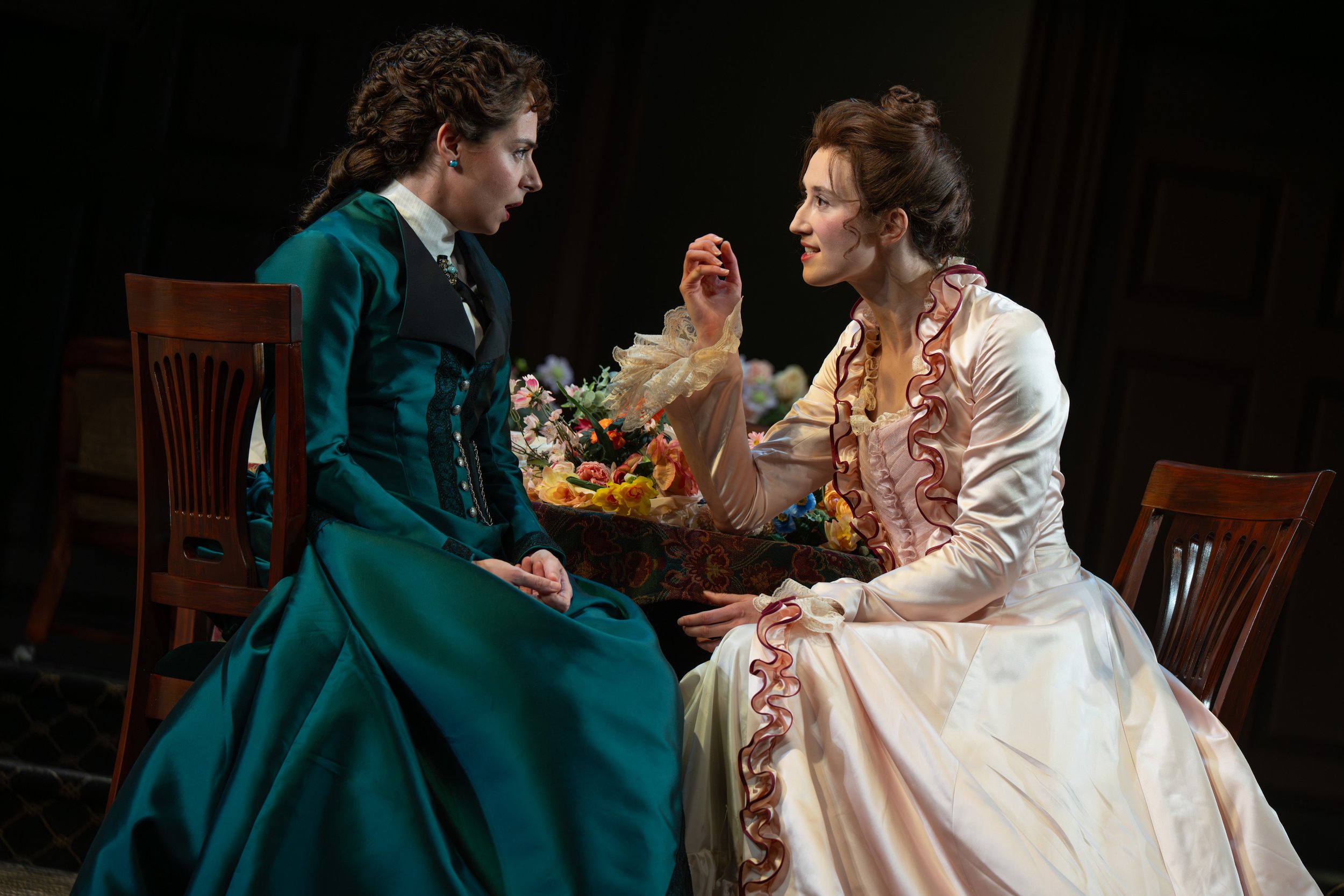
Thea Elvsted (Stephanie Machado), Hedda (Gabler) Tesman (Marianna Gailus) in Hedda Gabler, Yale Repertory Theatre; photo by Joan Marcus
As Mrs. Thea Elvsted, Stephanie Machado often can only stare open-mouthed at the sorts of things Hedda is apt to say, but her way with the role is impressive. Thea can easily be seen as somewhat air-headed, but here she is in her own quiet way a match for Hedda, so that the part she played in Eilert's reclamation and in the creation of his masterpiece feels believable and not simply a sentimental notion. As Eilert, James Udom's performance seems to me the most subtle. Eilert has a certain Byronism, both in the libertine past that fascinated Hedda and in his wish to defeat her husband Tesman "before the whole world." But Udom's Eilert, even when defeated himself, has the air of a man who has come into his own, having produced a work that proved to himself his own worth—and which stunned Tesman with its brilliance. The fact of that manuscript, and its ultimate fate, is at the center of the play—stirring envy in Tesman, hardhearted jealousy of Thea in Hedda, and ultimately producing despair in Thea and Eilert, as the "child" they can't bear losing.
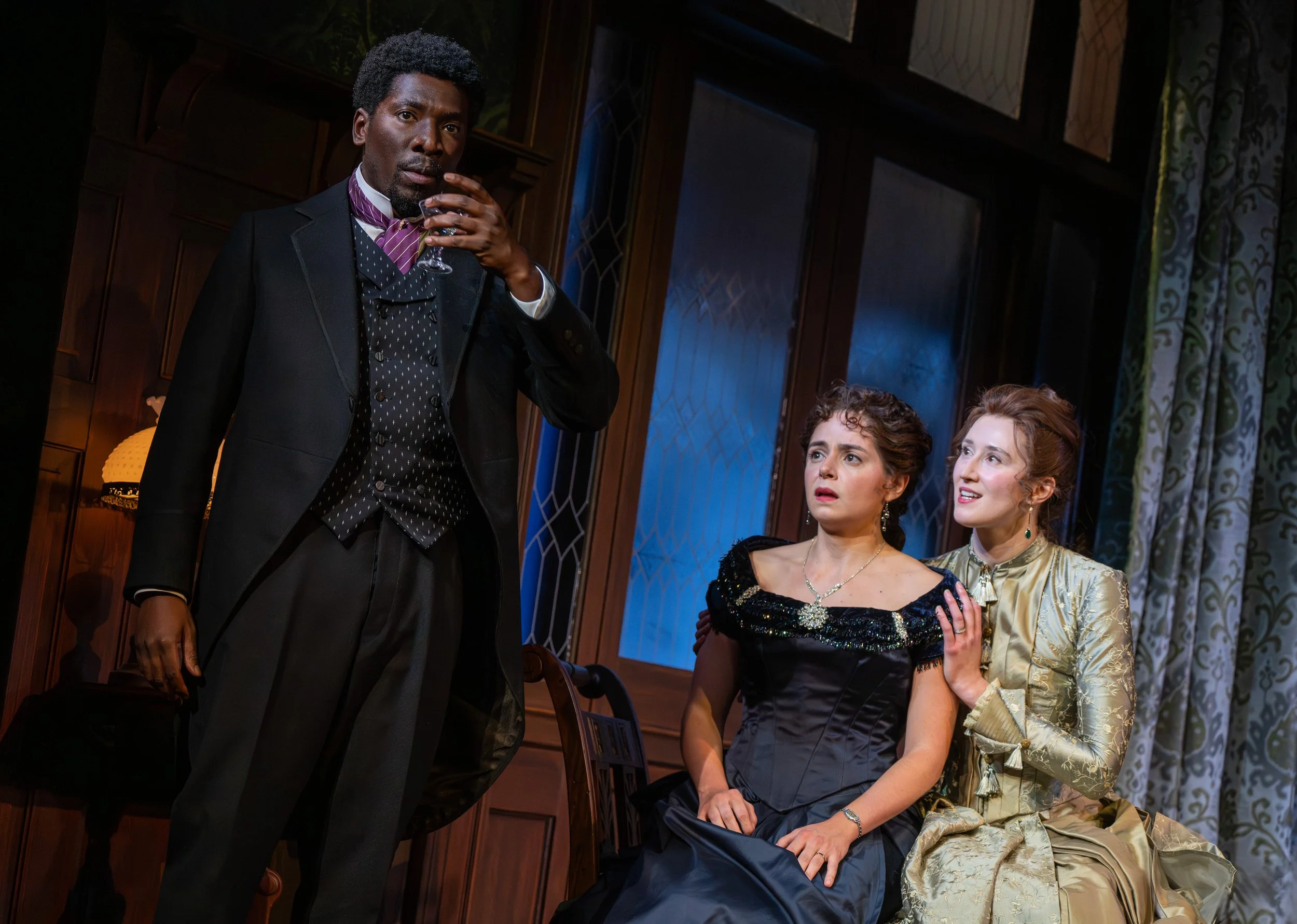
Eilert Løvborg (James Udom), Thea Elvsted (Stephanie Machado), Hedda (Gabler) Tesman (Marianna Gailus) in Hedda Gabler, Yale Repertory Theatre; photo by Joan Marcus
Hovering behind that birthing metaphor—spoken a few times—is the prospect of an actual child, never mentioned outright but tellingly implied, repeatedly, for Tesman and Hedda. Much of the cold fury in Hedda—and Gailus conjures it with brittle looks, or sets it aside with pregnant sighs—stems from a situation in which she cannot control her own destiny much less anyone else's. The world seems to conspire to disappoint her, making her final actions a last grasp at exerting her own will. As she says at one point: "Thoughts—they can't be mastered." Nor finally can Hedda.
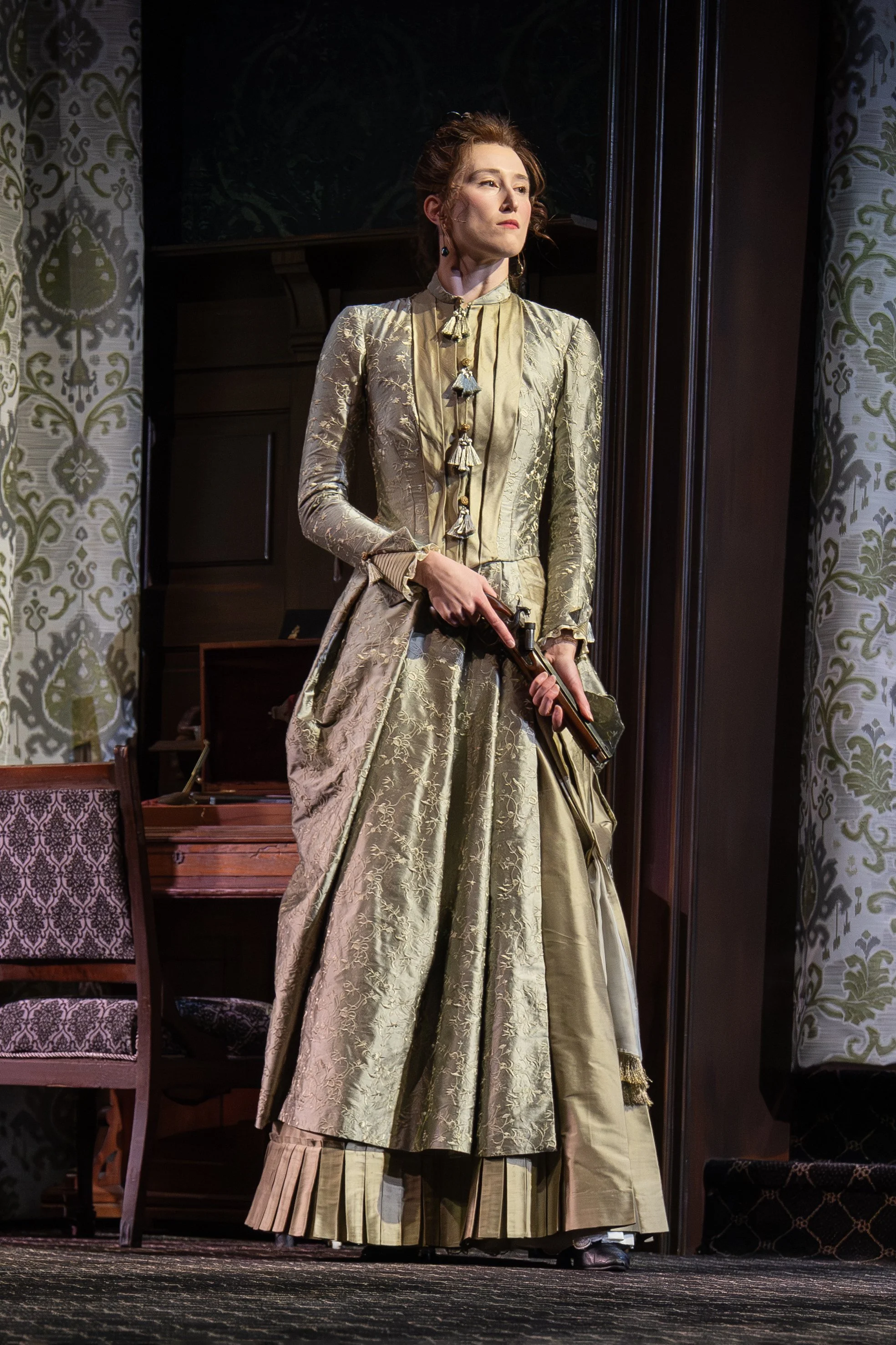
Hedda (Gabler) Tesman (Marianna Gailus) in Hedda Gabler, Yale Repertory Theatre; photo by Joan Marcus
Both devastating and archly ironic, there are few plays to match Hedda Gabler.
Hedda Gabler
By Henrik Ibsen
Translated from the Norwegian by Paul Walsh
Directed by James Bundy
Scenic Designer: Jessie Baldinger; Costume Designer: Lyle Laize Qin; Lighting Designer: Larry Ortiz; Sound Designer: Emilee Biles; Hair Designer: Matthew Armentrout; Production Dramaturg: Timothy Hartel; Technical Director: Steph Lo; Fight and Intimacy Director: Kelsey Rainwater; Vocal and Dialect Coach: Walton Wilson; Casting Director: Calleri Jensen Davis; Stage Manager: Narda E. Alcorn
Cast: Austin Durant, Marianna Gailus, Felicity Jones Latta, Stephanie Machado, Max Gordon Moore, Mary Lou Rosato, James Udom
Yale Repertory Theatre
November 28-December 20, 2025