Review of Rhinoceros, Yale Repertory Theatre
What do you do when everyone in your immediate vicinity (which, in the age of the internet is extensive) jumps on a bandwagon? Do you gleefully jump on too? Or do you respond skeptically, keeping the new idea, implement, technique, leader, faith at arm's length? Or do you turn vehemently against what "everyone else" has accepted?
No matter how you answer that question—or even if you find it too vague to be answerable—Eugene Ionesco's absurdist play Rhinoceros has something to say to you.
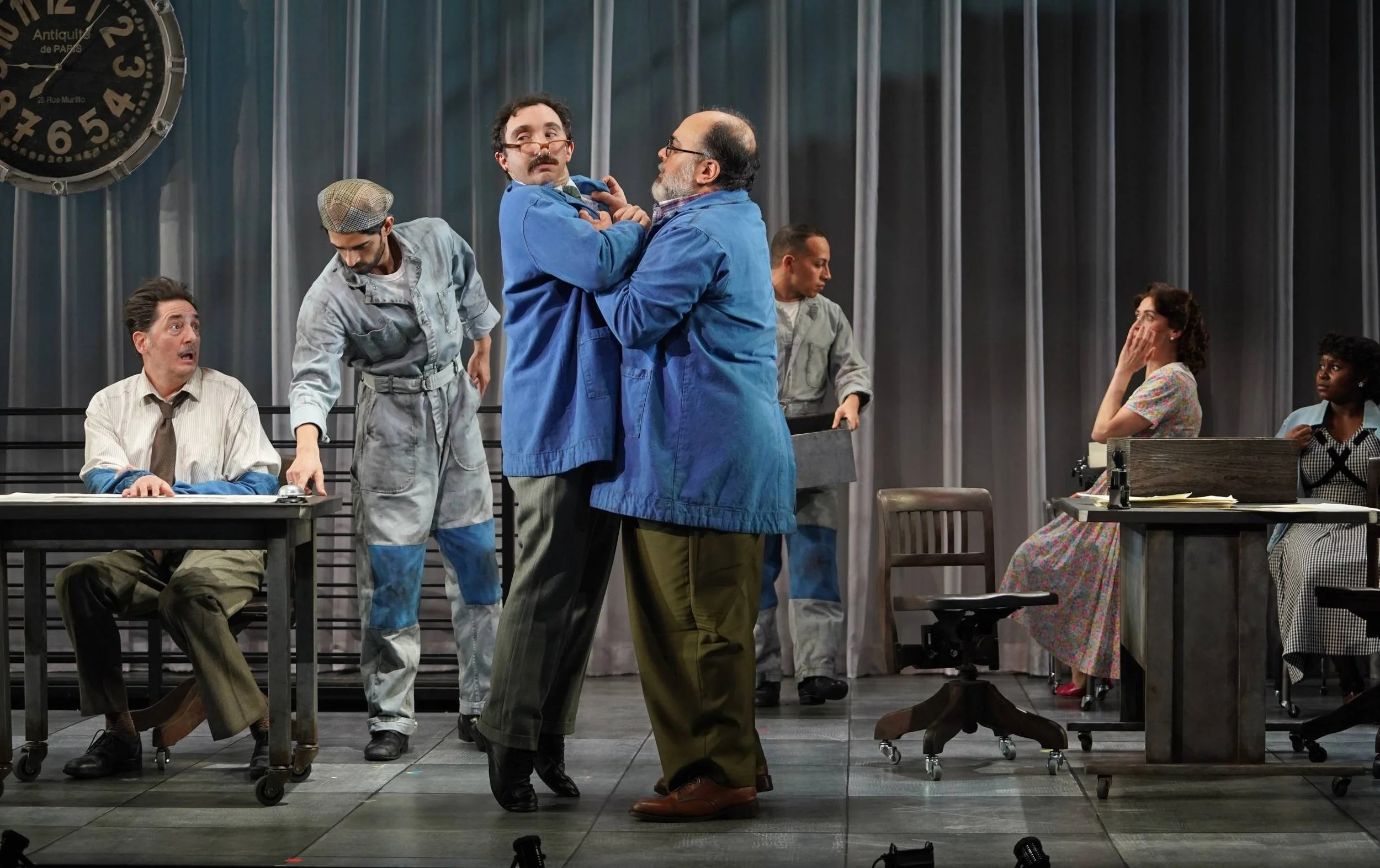
Berenger (Reg Rogers), townsperson (Ameya Narkar), Dudard (Will Dagger), Botard (Richard Ruiz Henry), worker (Jeremy A. Fuentes), Daisy (Elizabeth Stahlmann), Colette (Kimberly Vilbrun-François) in Eugene Ionesco’s Rhinoceros, adapted by Frank Galati, directed by Liz Diamond; Yale Repertory Theatre; photo by Carol Rosegg
Directed by Liz Diamond from a translation by Derek Prouse adapted by Frank Galati, with choreography by Emily Coates, the Yale Rep's Rhinoceros (playing through March 28), is fluid and fast, funny and frightening, with quick-change scenery in Jennifer Yuqing Cao's Scenic Design, complemented by many subtle effects in Donald Holder's Lighting Design and very effective and evocative Projection Design by Ke Xu. Then there's the Sound Design by Xi Lin, capable of giving a reality to those rhinos that become so overwhelming. Costumes, by Tricie Bergman, are visually splendid (there's a "funny papers" look to the whole) and, with shadowy lighting, suggest just enough of what the previously-human pachyderms might look like.
So, right from the start, this is a finely achieved theatrical world, which even namedrops its author when Gene (Philip Taratula) suggests his friend Berenger (Reg Rogers) should see an Ionesco play. We should see that play, we may assume, because we already are, but even more to the point, because we're living in it. For a few early scenes, we may not be sure what we're witnessing—any more than is Berenger or the unwitting others who believe they've just seen a rhinoceros run past an outdoor café in a smalltown. With that opening, we're off—but to where?
As the play goes on, with people turning into rhinos right and left, the rhinos are taking over, but Ionesco's attention is on the lone schlemiel or non-conformist or hapless Everyman for whom almost any situation—even getting and holding a job or telling a female coworker he likes her—is an existential crisis. Berenger is played by Reg Rogers, and he's phenomenal, with a voice that shakes and quakes and mutters and explodes and seems to veer about on a scale from ironically quizzical to borderline bonkers. It's a tour de force performance that sweeps us up into what could almost be considered one man's mania.
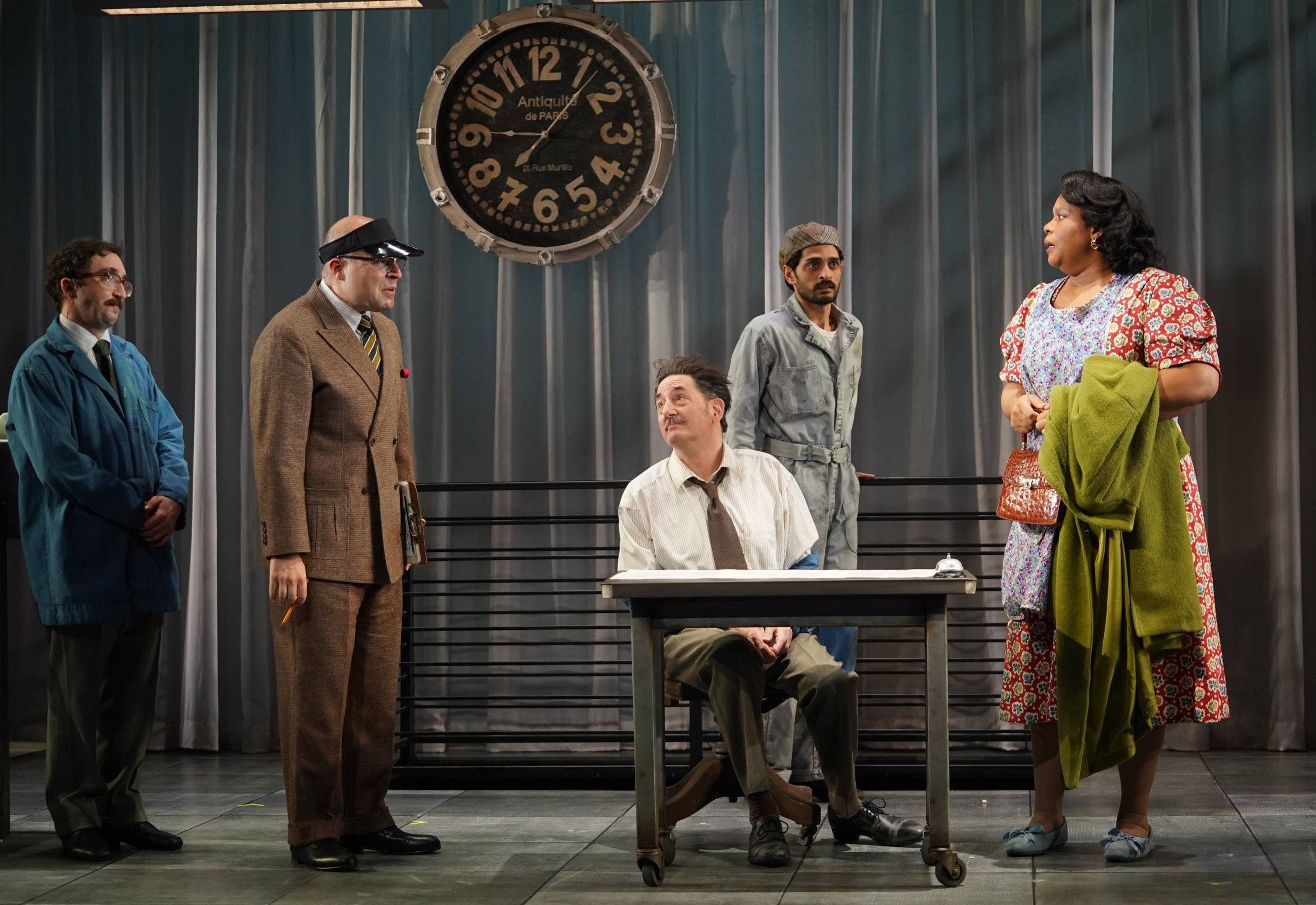
Dudard (Will Dagger), M. Papillon (Tony Manna), Berenger (Reg Rogers), townperson (Ameya Narkar), Mrs. Boeuf (Nicole Michelle Haskins) in Eugene Ionesco’s Rhinoceros, adapted by Frank Galati, directed by Liz Diamond, Yale Repertory Theatre; photo by Carol Rosegg
The most inventive scene is set in Berenger's workplace where the collected intellects try to grapple with what the newspaper says about rhinoceros sightings. Botard (Richard Ruiz Henry) takes the "don't believe everything you read, it's all propaganda" line, with which others may well be sympathetic, but the audience "saw" Berenger and other townsfolk "see" the rhino, and so did Berenger's co-worker Daisy (Elizabeth Stahlmann), a kind of "can-do Gal Friday," far too committed to the literal to be easily accused, as Berenger could be, of whimsy, hallucination or devil's advocacy. The kicking-about of the question goes on just long enough before a rhinoceros begins to encroach on the office from below. When Mrs. Boeuf (Nicole Michelle Haskins, a comic delight) recognizes the bellowing rhino as her own husband (who didn't go to work today as he was feeling strange), we might think we're venturing into campy sci-fi. But when Mrs. Boeuf does a wonderful slow-motion balletic run and jump onto the waiting back of her currently-quadruped spouse, we know we're in absurd allegory. What can the cast do but wave goodbye to Mrs. Boef and the world-as-they-knew-it.
Becoming a rhinoceros is the "new normal."
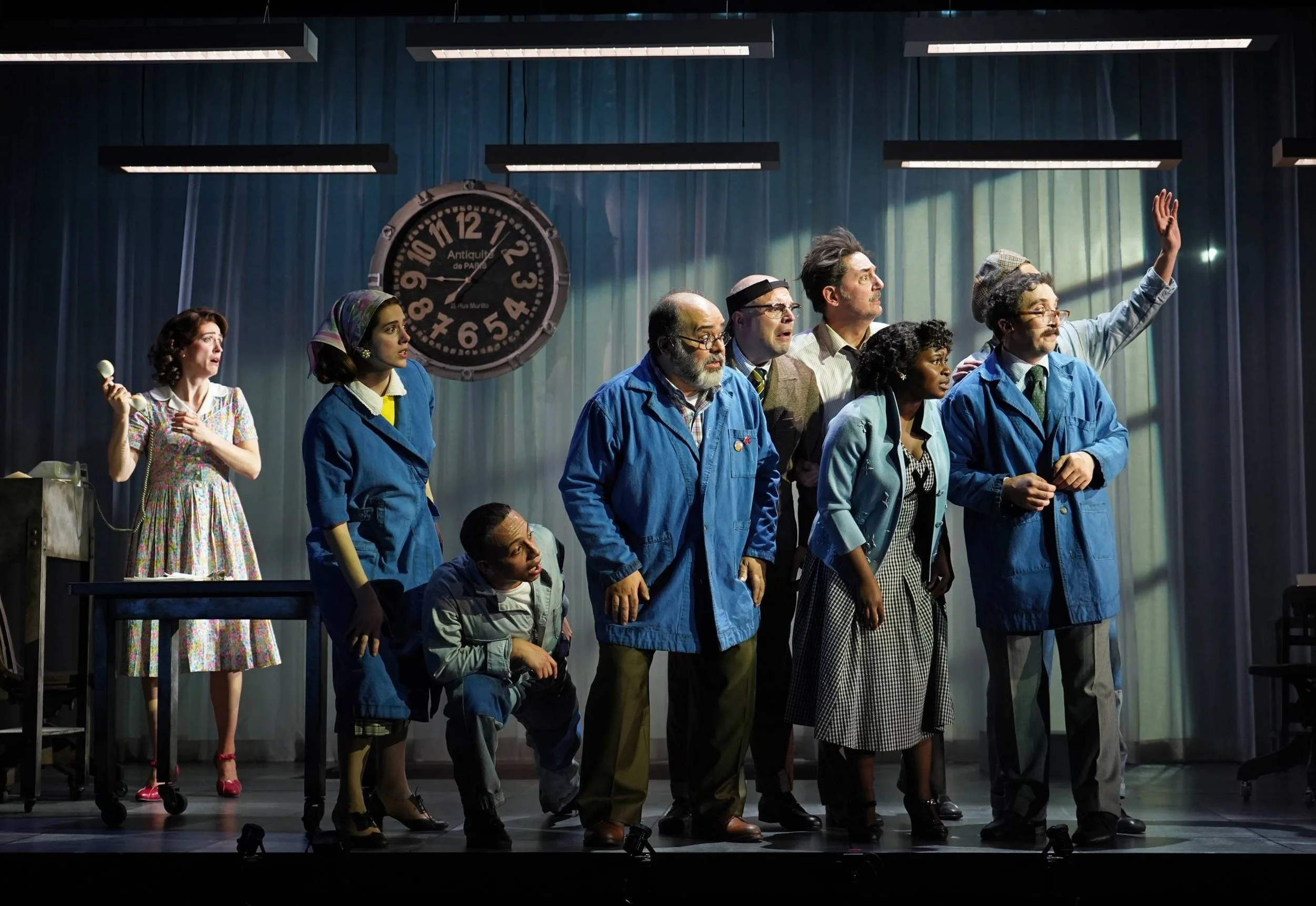
The cast of Eugene Ionesco’s Rhinoceros, adapted by Frank Galati, directed by Liz Diamond, Yale Repertory Theatre; photo by Carol Rosegg
I was hoping Ionesco would do another scene with multiple characters, but scenes with two or three characters—one of them always Berenger—dominate. There's a tradition of the absurd, coming from Beckett, that tries to see how interminable, offhand, and revealing a two-person colloquy can be. Berenger has two major scenes with Gene, played with a mixture of contempt and indulgence by Philip Taratula that, in some ways, are the entire play in miniature. In the first, at the café, we grasp how shaky a hero Berenger is; in the second, in Gene's bedroom, we watch Berenger become astounded by what he sees happening to Gene; in both, Gene stays reliably dismissive and self-involved, even as he becomes rhinocerosian before our eyes, advocating "primeval integrity" over "moral standards." The scene, in all its absurd horror, remains conversational and almost normal until Berenger must reluctantly admit that his best friend has become One of Them: a rhinoceros.
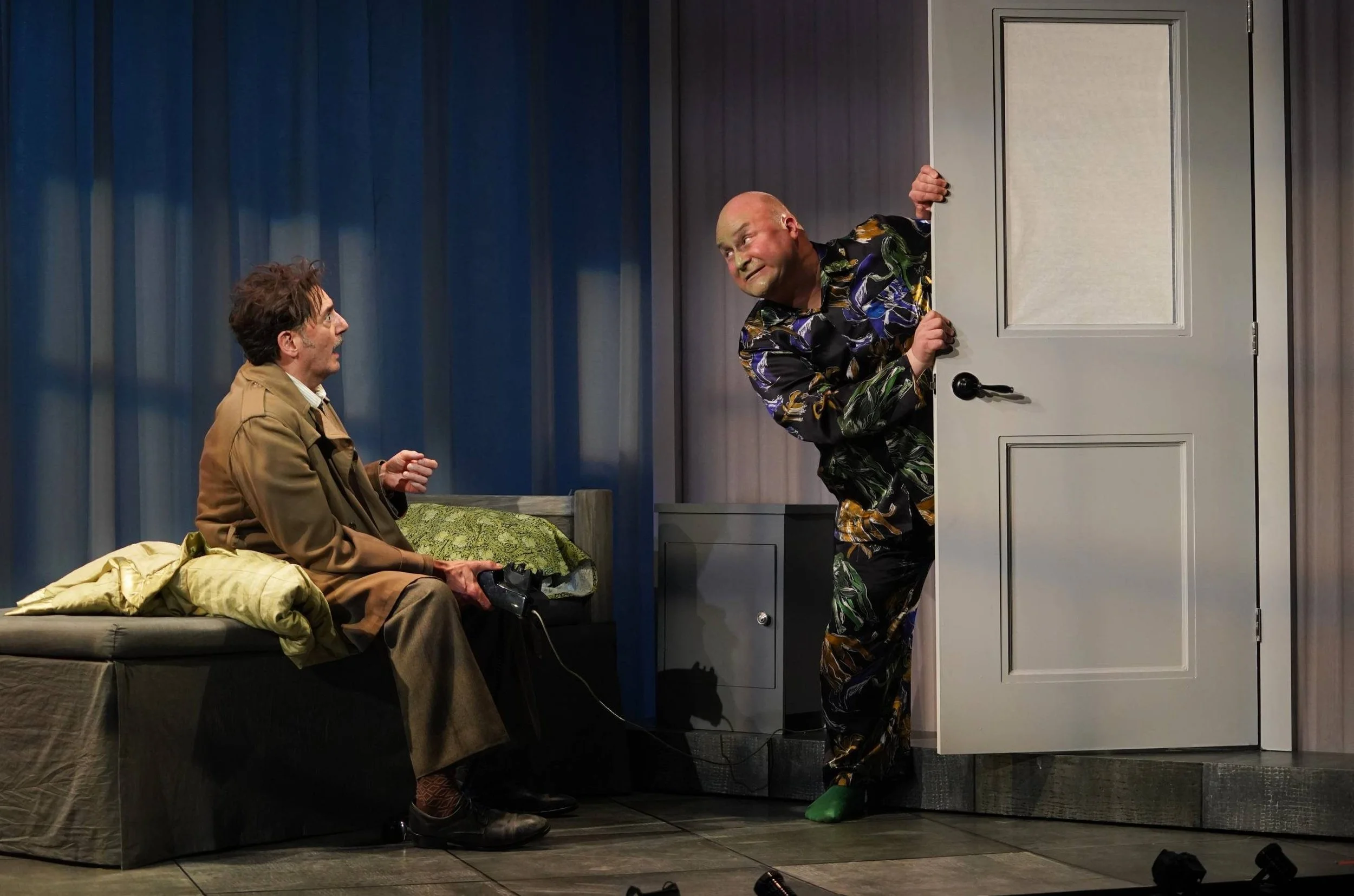
Berenger (Reg Rogers), Gene (Philip Taratula) in Eugene Ionesco’s Rhinoceros, adapted by Frank Galati, directed by Liz Diamond, Yale Repertory Theatre; photo by Carol Rosegg
(We might pause here and ask: why a rhinoceros? For theatrical purposes, a creature with fur or feathers would be easier to portray. And that might be reason enough not to choose one. Of course, Ionesco (I feel certain) would not allow that the animal was a matter of choice. People were turning into rhinoceroses, so what can you do but portray it? Still, as a mammal with a unique hide, and horns, and a belligerent quality, to say nothing of a herd instinct, the rhinoceros is well-chosen. In the post-World War II world (the play dates from 1959), after so much exposure to armed battalions in helmets and tanks, the rhino seems made to order as our best analog in the animal kingdom.)
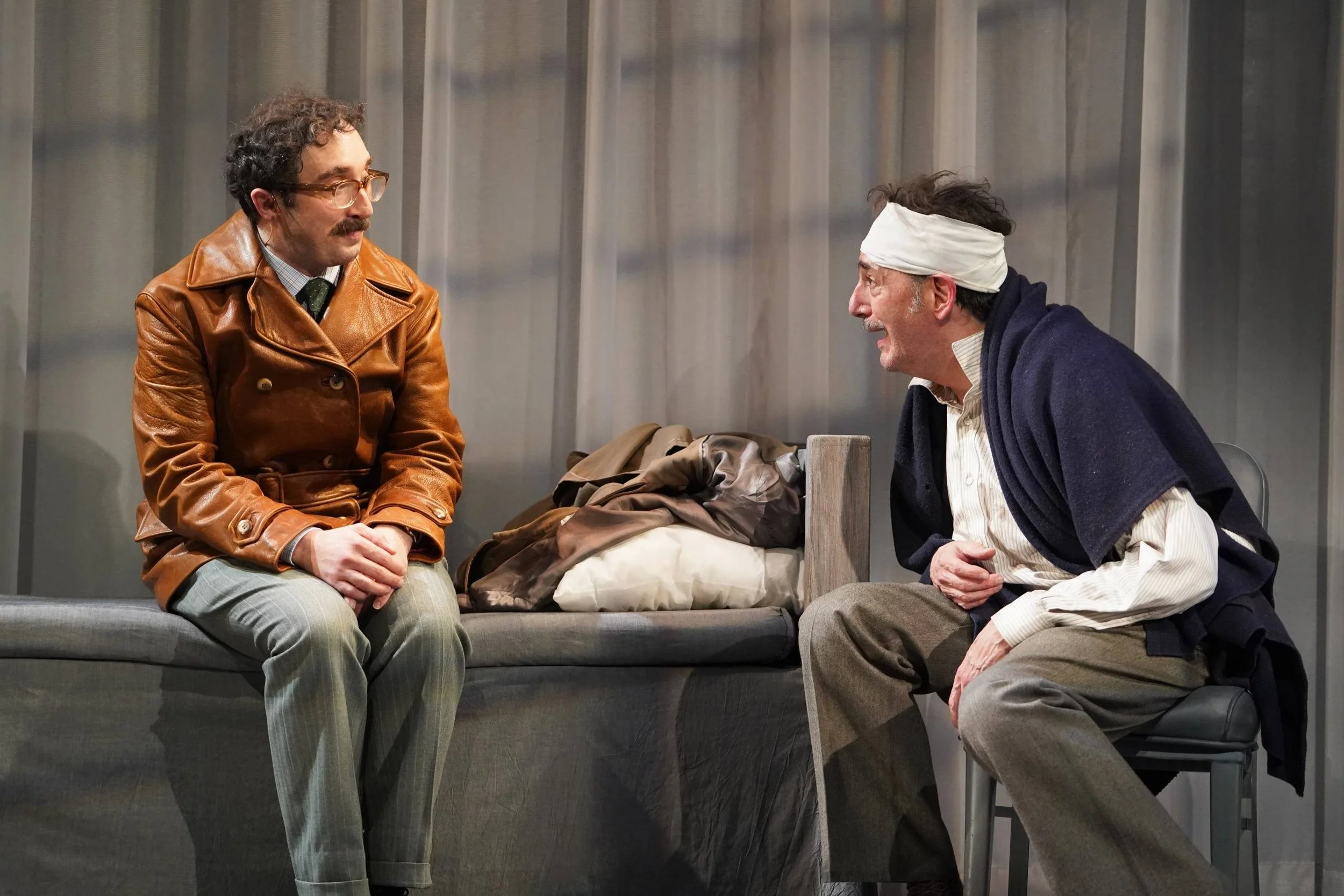
Dudard (Will Dagger), Berenger (Reg Rogers) in Eugene Ionesco’s Rhinoceros, adapted by Frank Galati, directed by Liz Diamond, Yale Repertory Theatre; photo by Carol Rosegg
Other scenes, later in the play, let Berenger interact with two characters that offer more subtle possibilities as his foils. Dudard, a canny pragmatist, played with comic intensity by Will Dagger, simply sees "rhinoceritis" as a disease, as something to get used to (shades of a pandemic), but which also may simply be "a question of personal preferences." Dudard slyly opens the door for our two great explanatory narratives: turning into a rhinoceros is natural, and so can't be helped; or social, and so then a matter of personal choice. In any case, just get on with what you must do, and maybe give it a try, out of curiosity. Or, if all your friends and coworkers and neighbors have transformed, it may become "a duty" to join them.
Dudard's choice becomes definite after Daisy arrives and he decides to quit the field, leaving Daisy to Berenger. The object of both men's affections, Daisy has a preference for Berenger and that touches him and gives him hope. Their dialogue, from a kiss to a slap—as Berenger says—"in the space of a few minutes" goes "through twenty-five years of married life." Likewise, Daisy—whom Stahlmann gives an earnest unselfconsciousness every step of the way—goes from sympathetic to supportive to stalwart to vacillating, disillusioned, and self-doubting, feeling that only "they"—the rhinoceroses—know what's best.
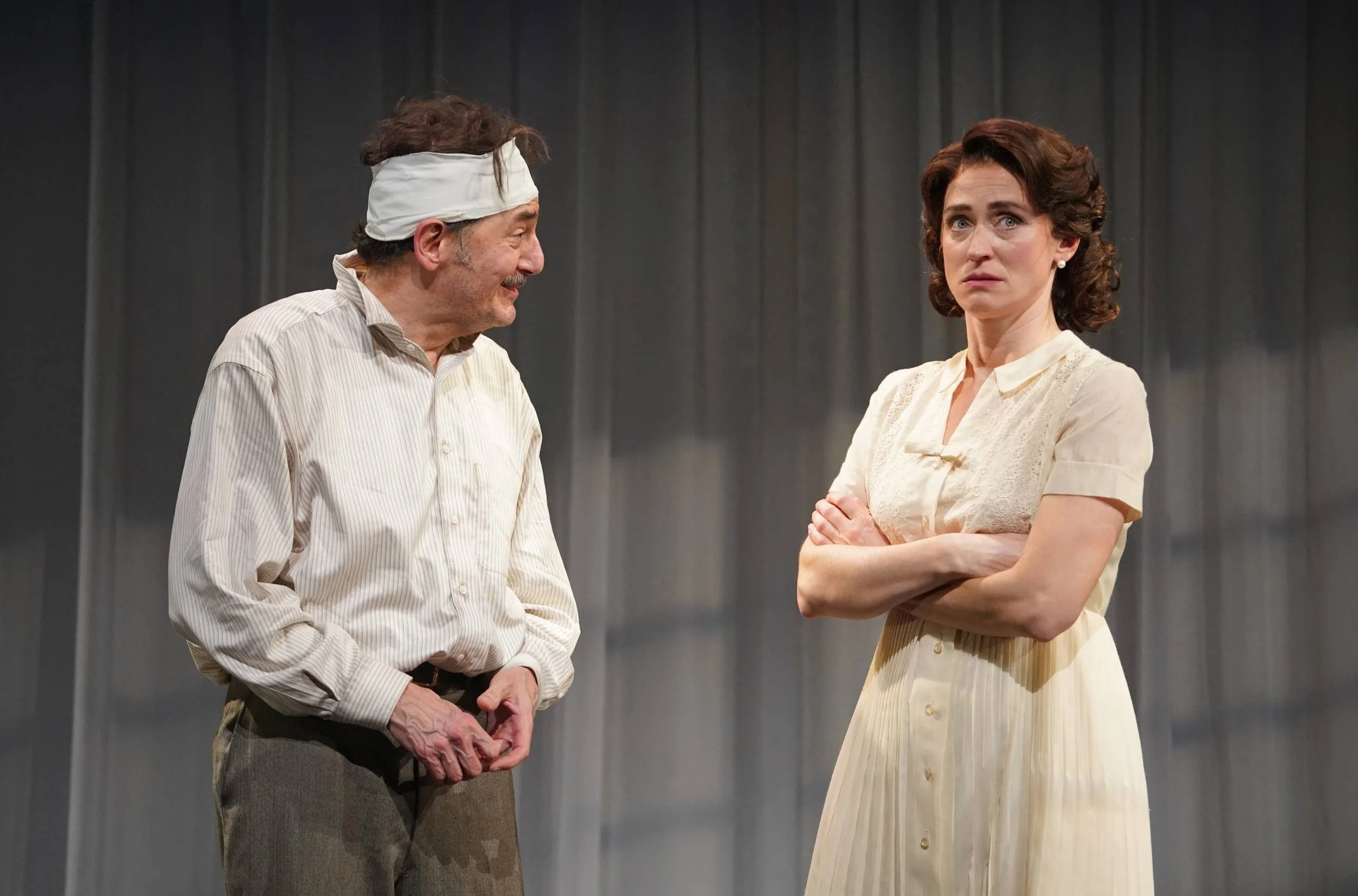
Berenger (Reg Rogers), Daisy (Elizabeth Stahlmann) in Eugene Ionesco’s Rhinoceros, adapted by Frank Galati, directed by Liz Diamond, Yale Repertory Theatre; photo by Carol Rosegg
Everyone knows the saying, "if you can't beat them, join them," which also applies, perhaps, to "if you can't escape them." Whatever hope Berenger holds onto as "human," refusing to capitulate, though individuality generally comes to "a bad end," must lie in his belief that he can decide for himself.
Ionesco's rhinos are what is often called "the wave of the future," and the play leaves to you what wave we may all be riding, to our ultimate consternation or certain doom or enslavement, or to the utter bankruptcy of purpose or of objective standards. If nothing else, becoming a rhinoceros would give us each a very thick hide.

Berenger (Reg Rogers) in Eugene Ionesco’s Rhinoceros, adapted by Frank Galati, directed by Liz Diamond, Yale Repertory Theatre; photo by Carol Rosegg
Rhinoceros
By Eugene Ionesco
Translated by Derek Prouse
Adapted by Frank Galati
Choreography by Emily Coates
Directed by Liz Diamond
Scenic Designer: Jennifer Yuqing Cao; Costume Designer: Tricie Bergmann; Lighting Designer: Donald Holder; Original Music and Sound Designer: Xi (Zoey) Lin; Projection Designer: Ke Xu; Hair, Wig, and Makeup Designers: The Wig Associates; Production Dramaturgs: Daria Kerschenbaum and Mia Van Deloo; Technical Director: Lilliana Gonzalez; Fight and Intimacy Director: Michael Rossmy; Vocal and Dialect Coach: Grace Zandarski; Casting Director: Calleri Jensen Davis; Stage Manager: Caileigh Potter
Cast: Will Dagger, Jeremy A. Fuentes, Nicole Michelle Haskins, Richard Ruiz Henry, Dorottya Ilosvai, Tony Manna, Ameya Narkar, Reg Rogers, Elizabeth Stahlmann, Philip Taratula, Kimberly Vilbrun-François
Yale Repertory Theatre
March 6-28, 2026