Review of Death of a Salesman, Hartford Stage
Hartford Stage has outdone itself this time! While the 60+ year-old playhouse is well known for reviving classic American plays, there are classics and then there are classics. Arthur Miller's Death of a Salesman, which dates from 1949, has the kind of cred and rep that are pretty much unshakeable. While certain elements to any play that old may seem dated, at this point the datedness is part of its power: we've always been aware that Miller was documenting a vanishing breed as well as looking askance at the predatory laws of the business jungle. His Willy Loman is a testament to a belief in "the little guy," while insisting that how the average working person fares, so fares the country. The loneliness of the long-distance salesman could never be so lonely now, in our world of interconnectedness via mobile phone and computer, so that revisiting that world—a past almost as mythic as the Greek tragedies Miller deliberately evokes—makes the two to three hour business of our stage feel grander and more archetypal than ever.
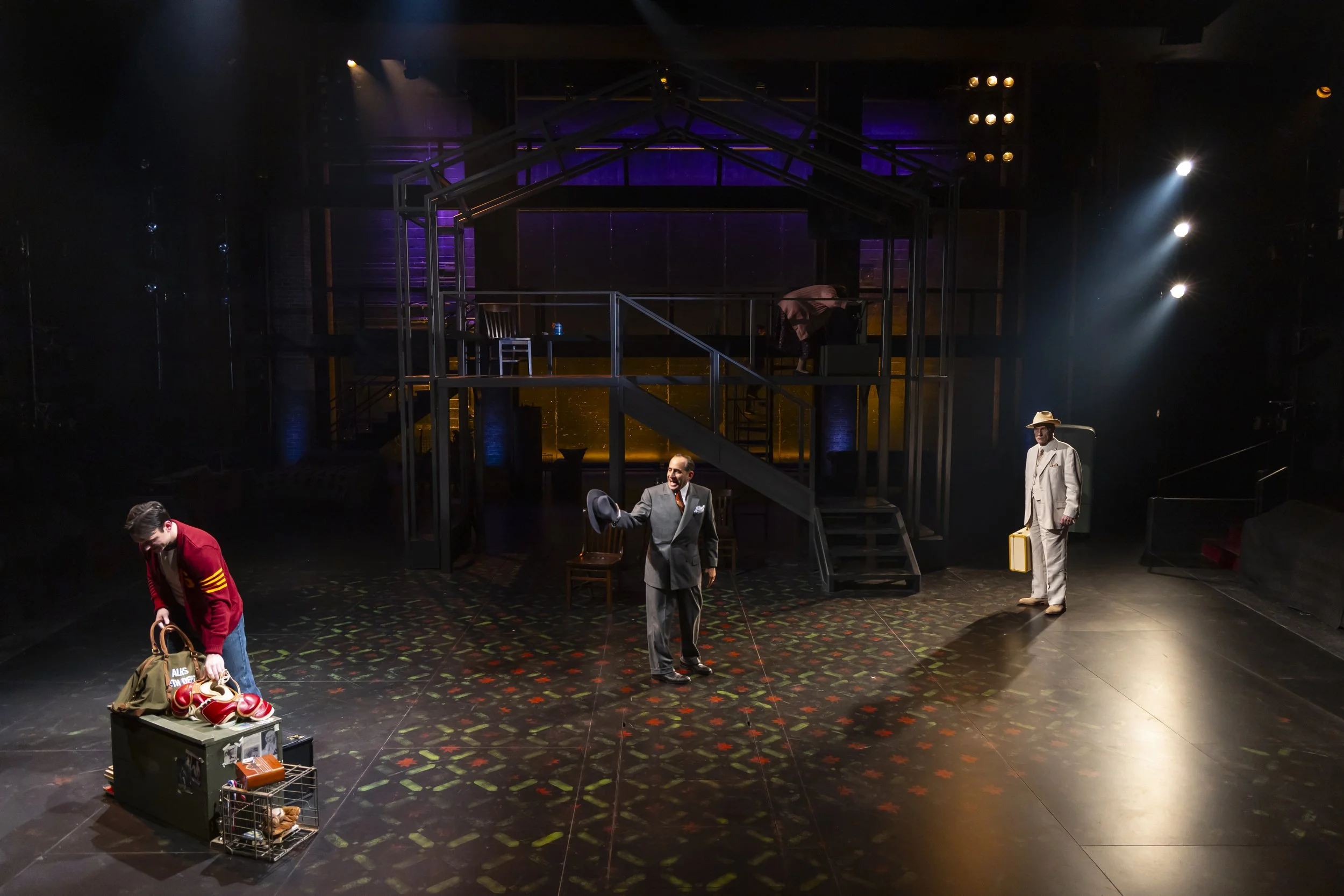
Biff (Samuel H. Levin), Willy (Peter Jacobson), Uncle Ben (Michael Cullen) in Death of a Salesman, directed by Melia Bensussen, Hartford Stage; photo by T. Charles Erickson
It's to the credit of Melia Bensussen, director of this production, and Artistic Director of Hartford Stage, that the pacing of the production is so incredibly deft. The casting is superb, and the tech—as we've come to assume at Hartford Stage—top notch. Miller, as the playbill reminds us, imagined his play as taking place in Willy Loman's mind, so the playing space has to shift and change with the action. Sara Brown's versatile set, paired down to essential furniture and scaffolding, with amazingly evocative lighting by Matthew Richards, allows for movement in the foreground and the background as well as providing a completely surrounded feeling. The space can be open and distancing and at times surprisingly claustrophobic, so intensely do the actors manifest the differences in setting (greatly assisted by Darron L. West's sensitive and evocative sound design and music). Each scene runs flawlessly into the next, creating a compelling cumulative feel that attests to why it's so important to see an actor live out such a role fully, relentlessly.

Biff (Samuel H. Levine), Willy (Peter Jacobson), Happy (Max Katz) in Death of a Salesman, directed by Melia Bensussen, Hartford Stage; photo by T. Charles Erickson
Peter Jacobson's Willy Loman looks and sounds exactly right, which occurred to my mind as "a Jewish Spencer Tracy." The "Tracy aspect" means there is an essential trustworthy, right-minded, homey comfortableness in Willy, and also the kind of affability that makes us believe he once was a major earner as a salesman (though his glory days were the 1920s). Some of that engaging manner still comes through, layered over by hard denials and over-the-top delusions that fuel at times a kind of mania. I came away with so many little "clips" of Jacobson—the way he goes up on his toes (almost everyone is a little taller than he is, or even considerably taller), the donning and removing his jacket as if completely absentminded, the veering so quickly from pleading to demanding or from boundless joy to defeated pathos, and always the hands in movement, speaking a language of their own. It's a genuinely great performance, nuanced and perceptive, and Jacobson's final exit stands out in its use of the Hartford Stage space that impresses as a last glimpse of Willy's lonely, self-absorbed dignity.
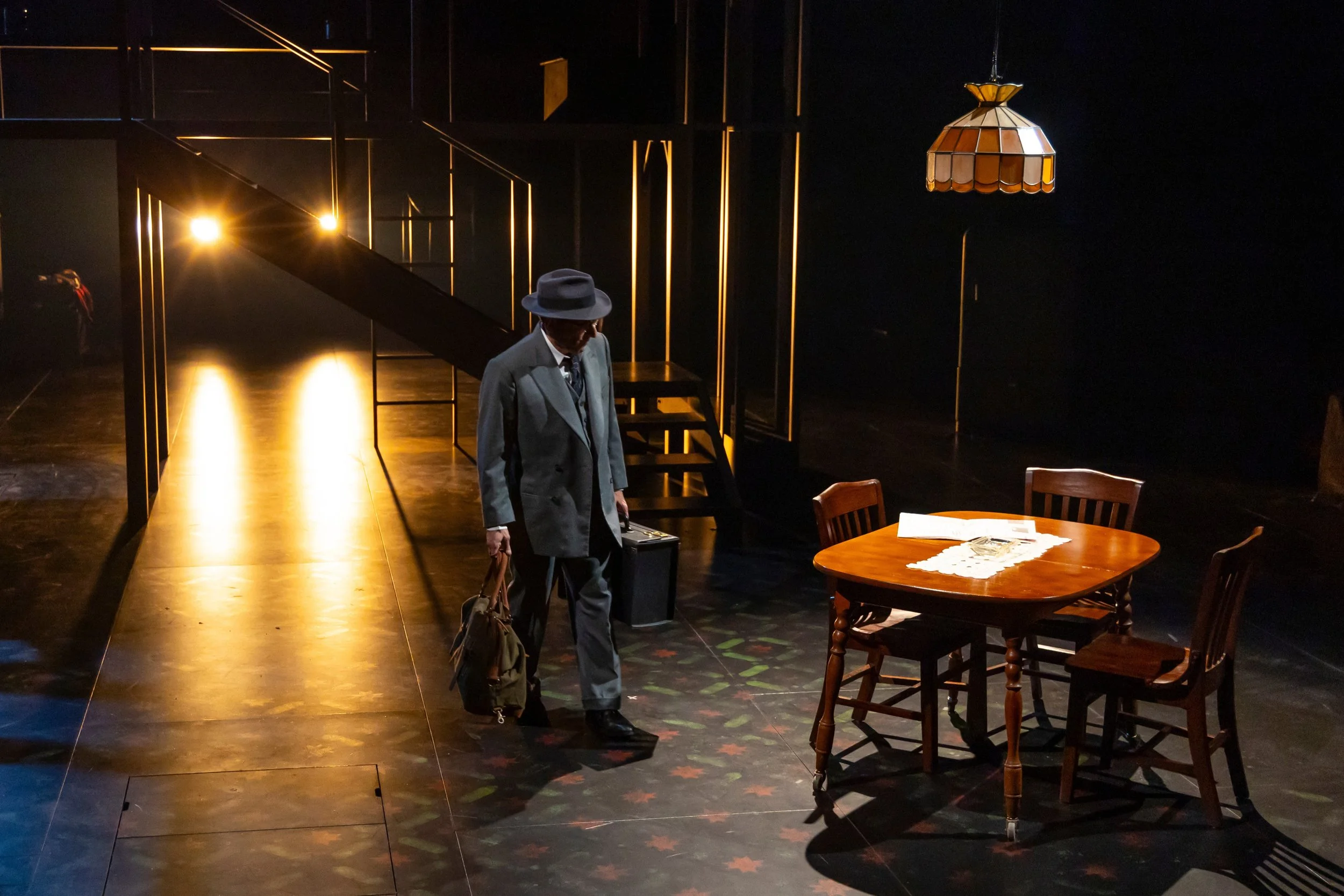
Willy Loman (Peter Jacobson) in Death of a Salesman, directed by Melia Bensussen, Hartford Stage; photo by T. Charles Erickson
As Linda Loman, Adriene Krstansky gets the last word, and her speech is a powerful flow of grief, regret, love coupled with and almost crippled by disbelief and confusion. Krstansky, like Jacobson's Willy, lets us see many sides to Linda, at times the doting wife, at times the tough-love mother, at times the bedrock reality in contrast to Willy's shaky constructions. She delivers the famous demand "attention must be paid" as the back-against-the-wall moment it is. She is the one who all along has paid attention to the rise and fall of her striving husband, seeing his pride flair up again and again no matter how beaten and, as she says, "tired." Not so much a victim of Willy, as his sons are, but rather a damaged witness.

Linda Loman (Adrienne Krstansky) in Death of a Salesman, directed by Melia Bensussen, Hartford Stage; photo by T. Charles Erickson
There is much excellent support here as well, in the kinds of rich character-actor roles that Miller had a definite knack for creating. Loman's sons, Biff (Samuel H. Levine) and Happy (Max Katz) run us through the paces from children adoring their father and delighted whenever he's home from the road, to containers of all his hopes who will likely never satisfy his need for their unparalleled success. Levine gives us Biff's charisma while showing the nagging uncertainty that undermines his best efforts.
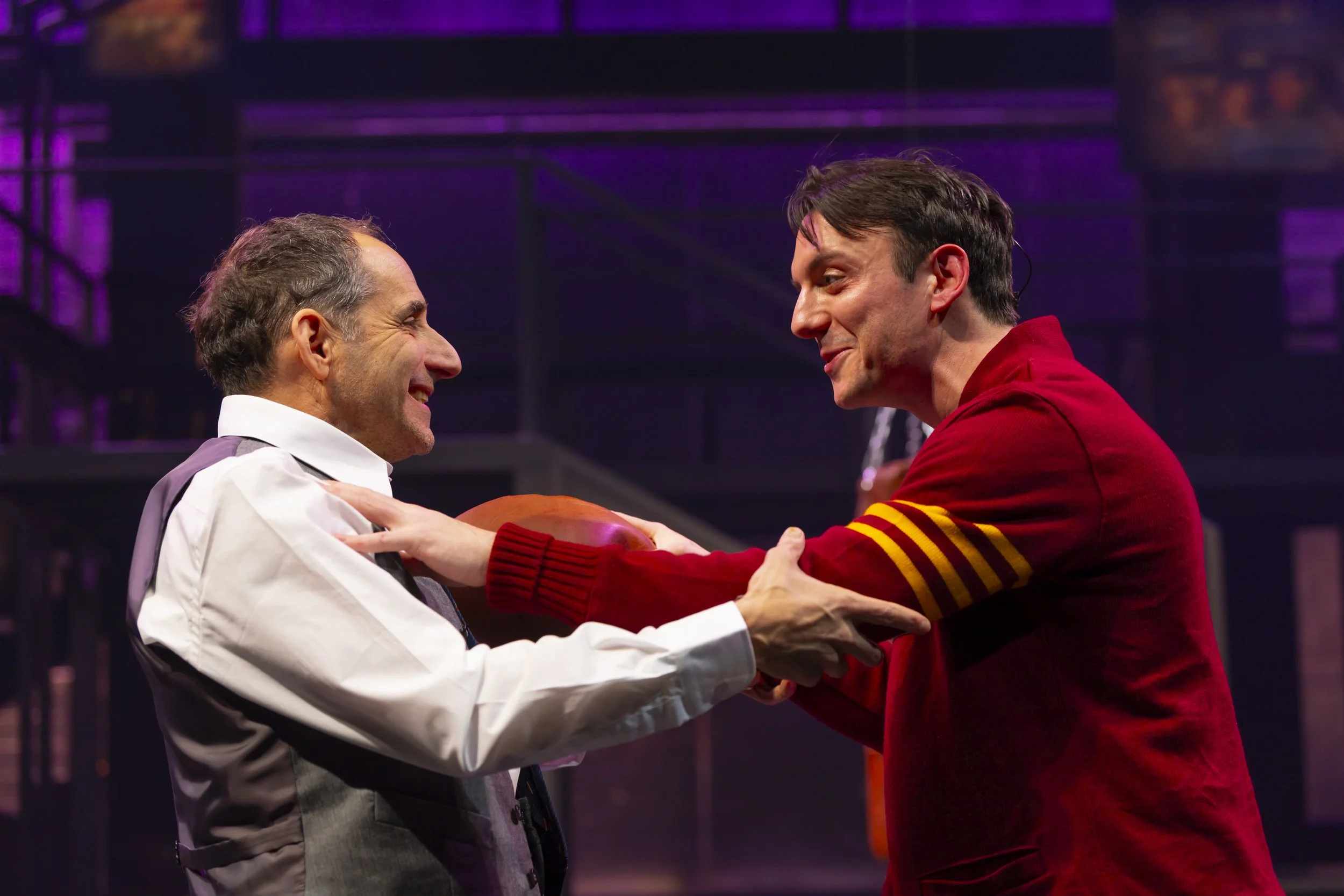
Willy (Peter Jacobson), Biff (Samuell H. Levine) in Death of a Salesman, directed by Melia Bensussen, Hartford Stage; photo by T. Charles Erickson
The big reveal scene—where we learn the rift between father and son is a shameful secret never addressed—shows us how little the two are prepared for the realities of life. They have to pretend to be what they're not and pretend that things they know aren't so. The situation itself could almost be comic, but its implications go deep to the heart of what causes so much sorrow for this family.
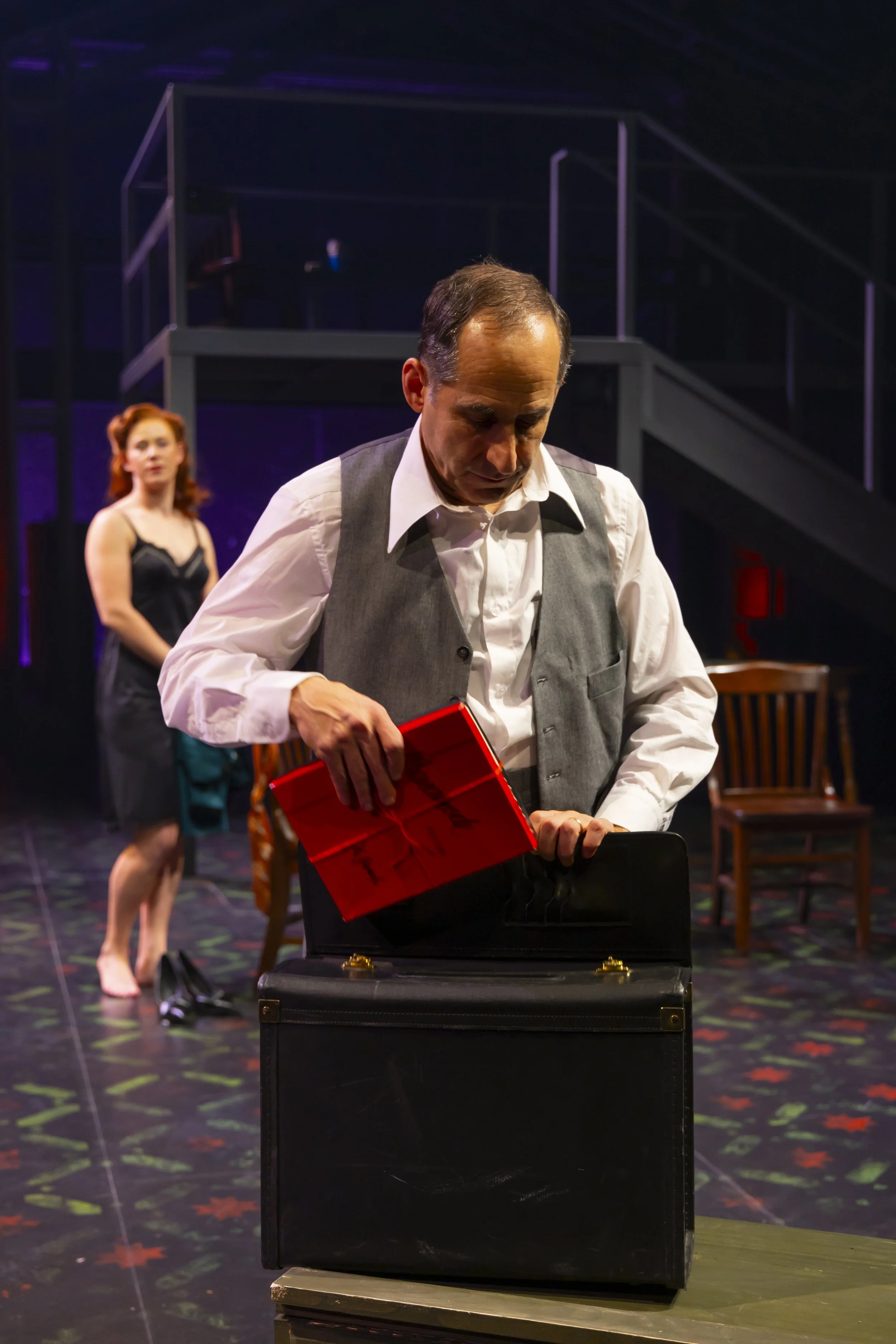
The Woman (Nora Eschenheimer), Willy (Peter Jacobson) in Death of a Salesman, directed by Melia Bensussen, Hartford Stage; photo by T. Charles Erickson
Katz's Happy, who exudes the shrugging nonchalance of a Brooklyn skirt-chaser, is damaged in his own way, as feckless and obtuse as Biff is troubled and morose. The scene when the planned celebratory dinner between Loman and sons goes awry demonstrates how keeping such disparate types under one roof—as family—is an epic struggle doomed to fail.
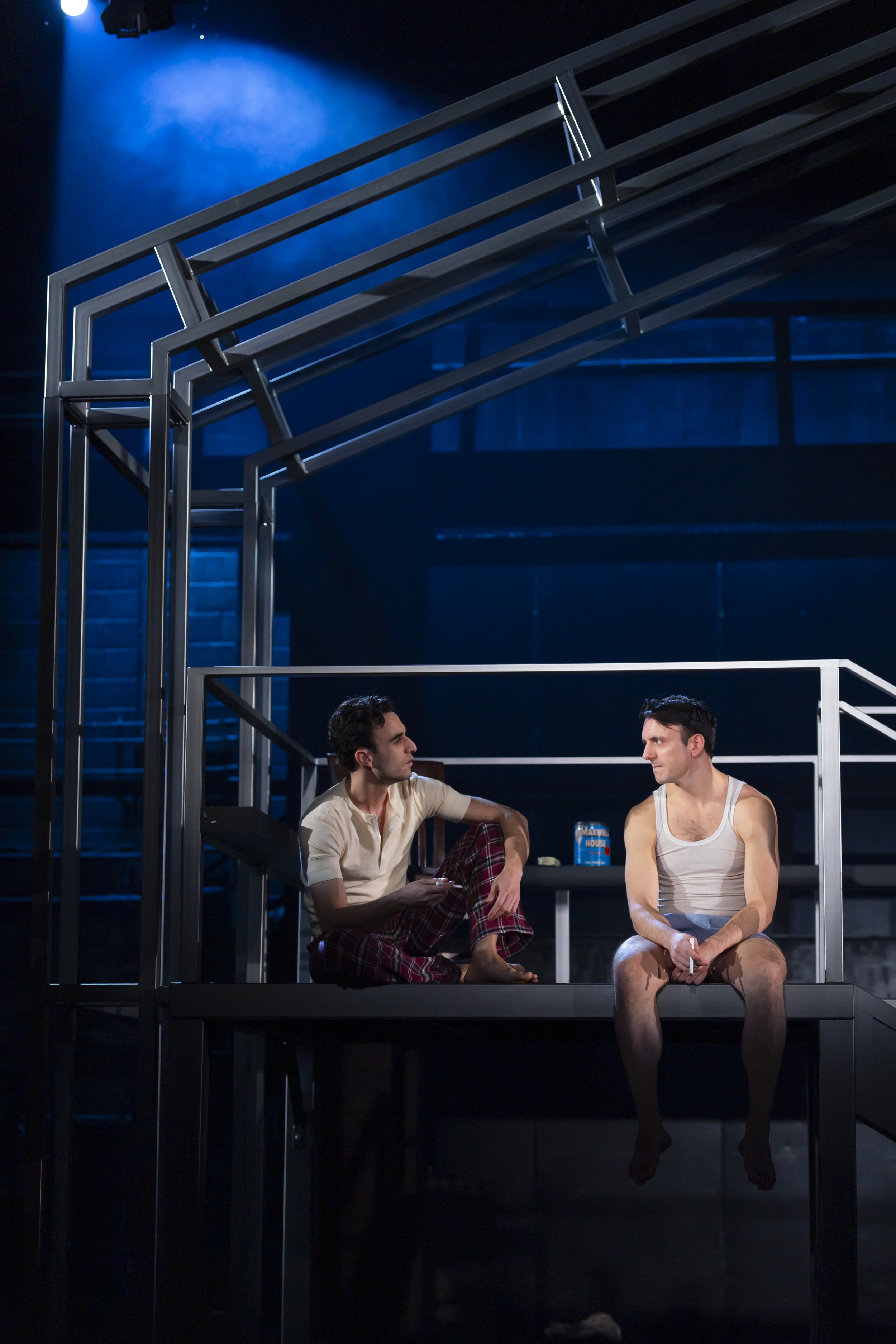
Happy (Max Katz), Biff (Samuel H. Levine) in Death of a Salesman, directed by Melia Bensussen, Hartford Stage; photo by T. Charles Erickson
Smaller parts, no less notably realized: Michael Cullen as the steely ghost of Willy's brother Ben who steals into Willy's thoughts whenever he needs to praise a hero who "walked into the jungle at 17 and walked out at 21, rich." He's a figure who becomes more baleful as the play goes on; Stephan Cefalu, Jr., as a classmate of Biff's who, in Willy's memory, is a nerdy nobody and then, as an adult, the kind of self-effacing success that Willy can't quite credit, much as his pride won't let him acknowledge he truly needs the help of his neighbor Charley (Paul Michael Valley), who goes from a joshing to a pitying foil. The one-upmanship that Willy thrives on could have been benign once upon a time, now it's all wormwood. Likewise, his attempts to maintain an avuncular tone with his boss, Howard (Patrick Zeller), creates a telling scene that shows the minefield in Willy's mind, where any wrong step, wrong word will precipitate him into unspeakable loss—not only of livelihood but of every dream he still needs to believe. It's all very gripping and sharply ironized.
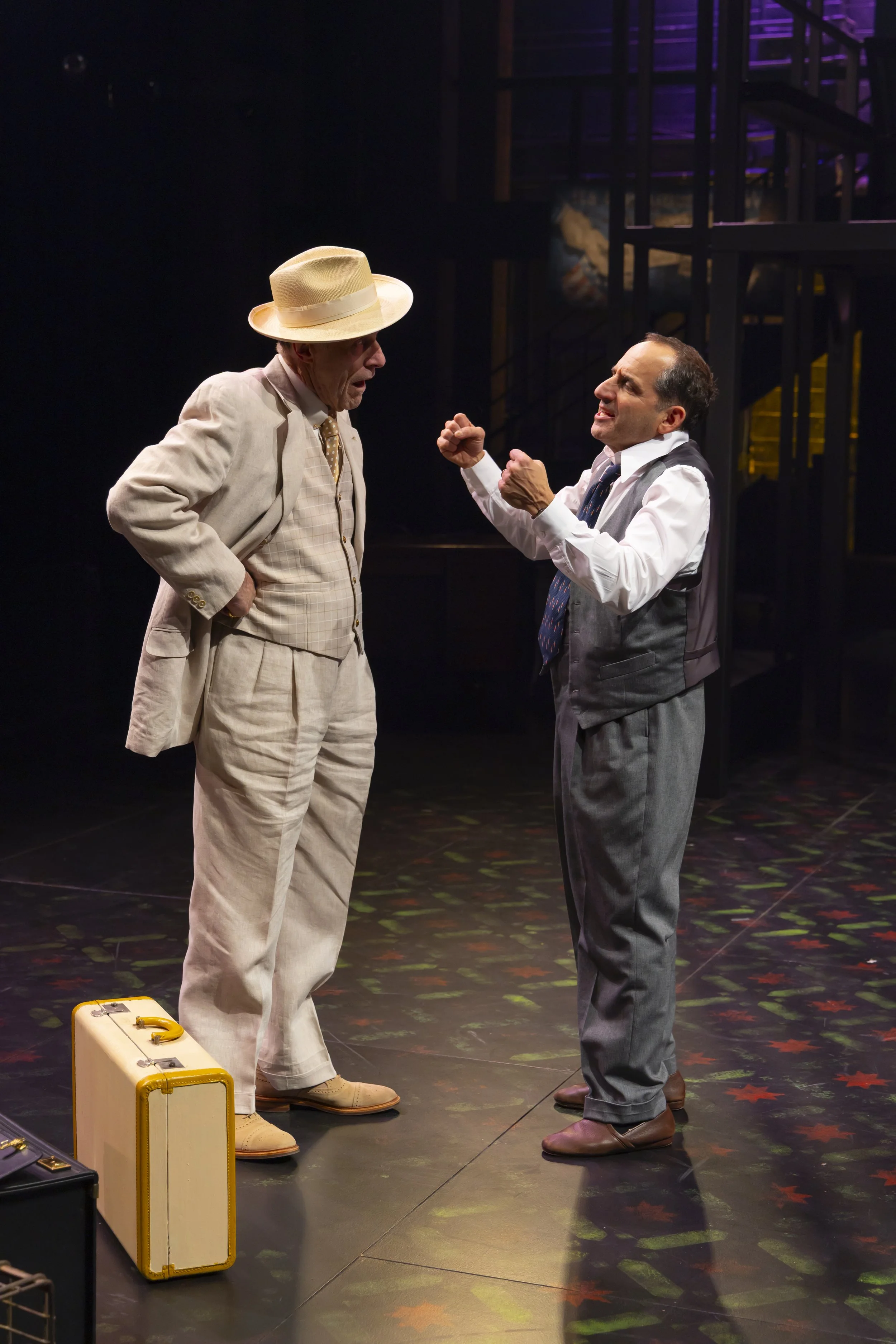
Uncle Ben (Michael Cullen), Willy (Peter Jacobson) in Death of a Salesman, directed by Melia Bensussen, Hartford Stage; photo by T. Charles Erickson
As the "other woman," Nora Eschenheimer gives presence and personality to The Woman, a role so underwritten as to border on fantasy, so that it's important to believe in her as a real person; as Miss Forsythe, a woman Happy meets casually in a restaurant, Rebecca Strimaitis portrays a cautious willingness to be charmed. Both scenes are marked by how little the women matter to the men, except as prizes won or as audience to skill or wit or to the spending of money. There are two kinds of women in the world of this play: the stay-at-home support, and the ones who try to make their way in the "man's world" of the times.
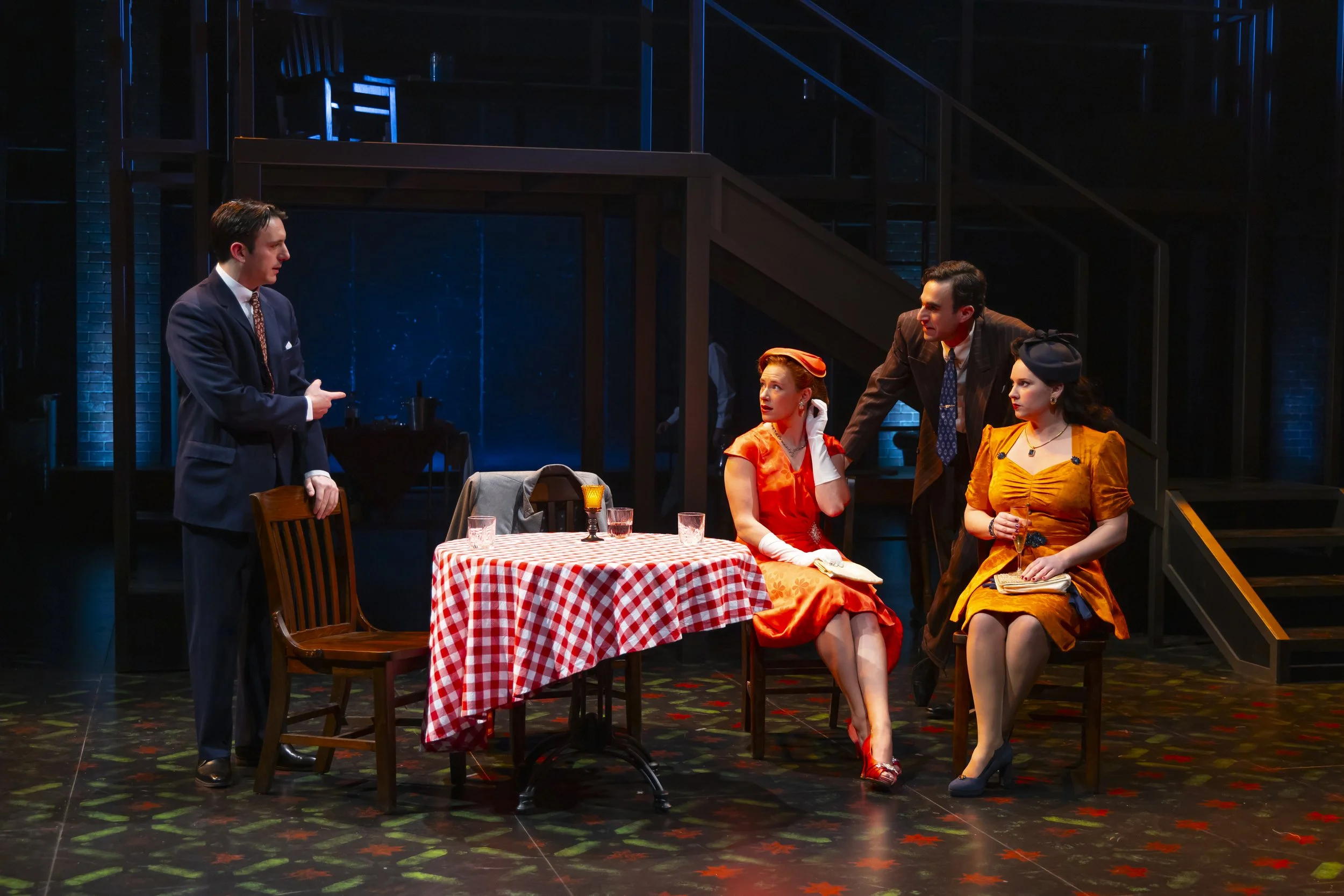
Biff (Samuel H. Levine), Letta (Nora Eschenheimer), Happy (Max Katz), Miss Forsythe (Rebecca Strimaitis) in Death of a Salesman, directed by Melia Bensussen, Hartford Stage; photo by T. Charles Erickson
Death of a Salesman's rich central character has been portrayed by many great actors, among them Lee J. Cobb, George C. Scott, Dustin Hoffman, Brian Dennehy, Philip Seymour Hoffman, Wendell Pierce. A Broadway revival of the play will be opening soon, with Nathan Lane and Laurie Metcalf. It may indeed be superlative, but if you care about this play, do yourself a favor and get to Hartford for this one. When I think of Death of a Salesman from now on, it's going to be Peter Jacobson's Willy Loman I will remember.
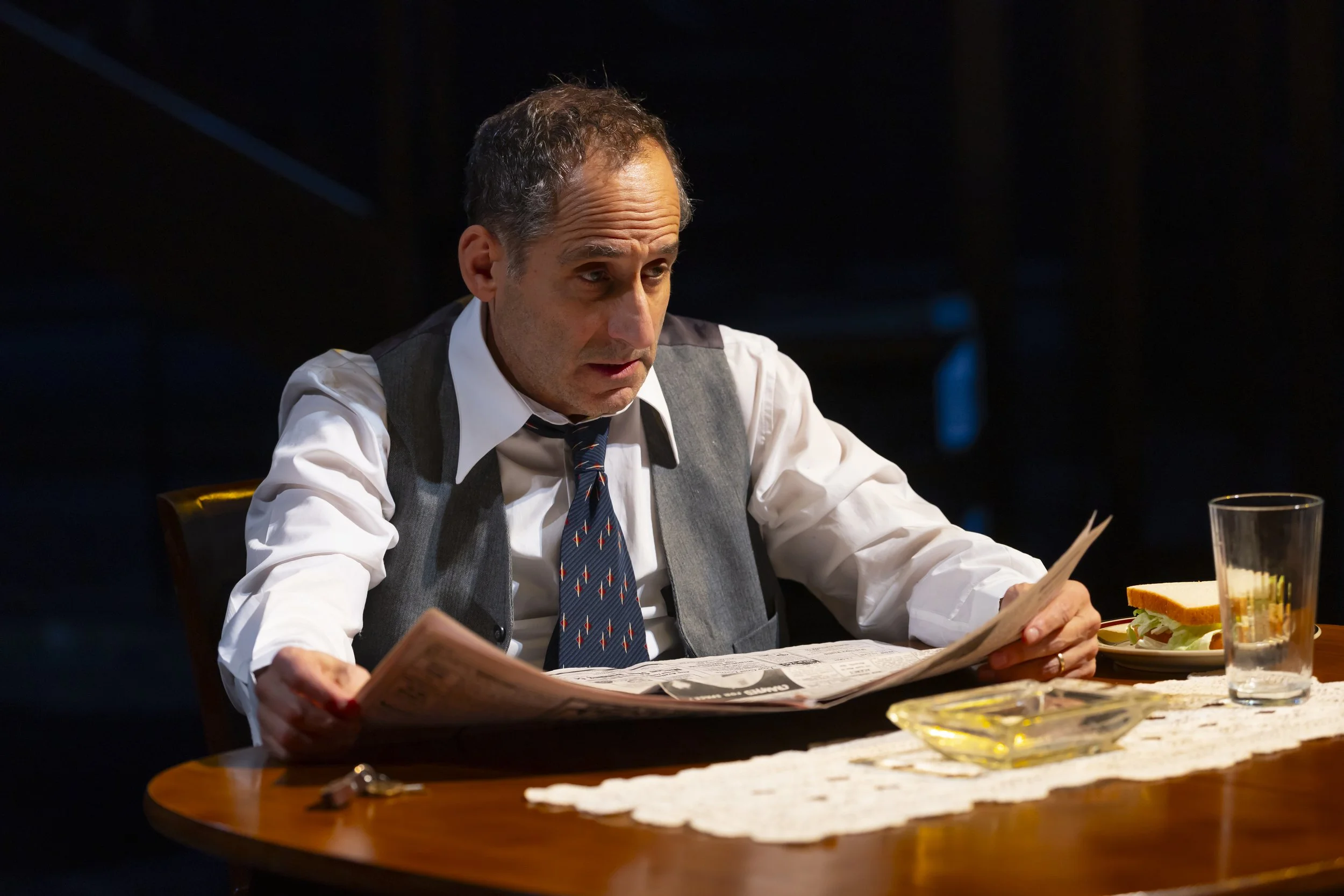
Willy Loman (Peter Jacobson) in Death of a Salesman, directed by Melia Bensussen, Hartford Stage; photo by T. Charles Erickson
Death of a Salesman
By Arthur Miller
Directed by Melia Bensussen
Scenic Design: Sara Brown; Costume Design: Harry Nadal; Lighting Design: Matthew Richards; Sound Design: Darron L. West; Wig, Hair & Make-up Design: J. Jared Janas; Fight Director: Ted Hewlett; Dialect & Voice Coach: Julie Foh; Casting: Alldaffer & Donadio Casting; Production Stage Manager: Nicole Wiegert; Assistant Stage Manager: Julius Cruz; Associate Artistic Director: Zoë Golub-Sass; Director of Production: Bryan T. Holcombe; General Manager: Emily Van Scoy
Cast: Stephan Cefalu, Jr.; Michael Cullen; Nora Eschenheimer; Mike Houston; Peter Jacobson; Max Katz; Adrianne Krstansky; Samuel H. Levine; Rebecca Strimaitis; Paul Michael Valley; Patrick Zeller
Hartford Stage
February 27-March 29, 2026